
Featured insight
I Stopped Watching Prompt Engineering Tutorials and Started Playing Games Instead - Here's Why I Learn Faster Now

Priyap01
June 9, 2026•9 min read
#explore rentprompts
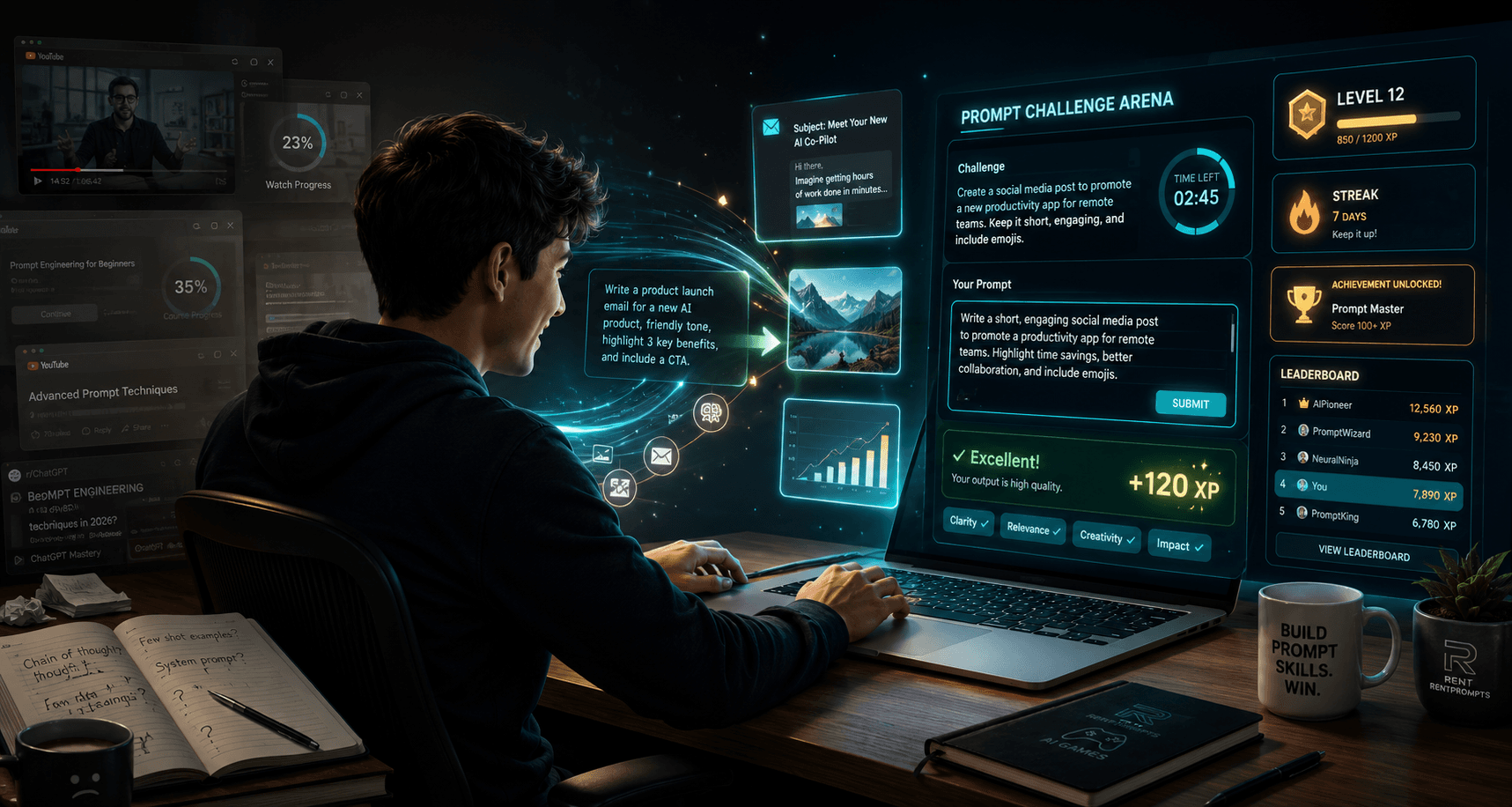
Sometime last November, I had seventeen browser tabs open.
Four were YouTube tutorials on prompt engineering. Two were paid courses I'd bought and never finished. One was a Reddit thread where someone was arguing about whether chain-of-thought prompting was really a skill or just a trick. The rest were various AI playgrounds where I'd typed a few things, gotten mediocre results, and then closed the tab when I didn't understand why my prompts weren't working.
I'd been "learning prompt engineering" for three months. I knew the vocabulary. I could explain few-shot prompting at a dinner party. I had watched hours of content from people who were clearly very good at this.
I couldn't actually write a great prompt to save my life.
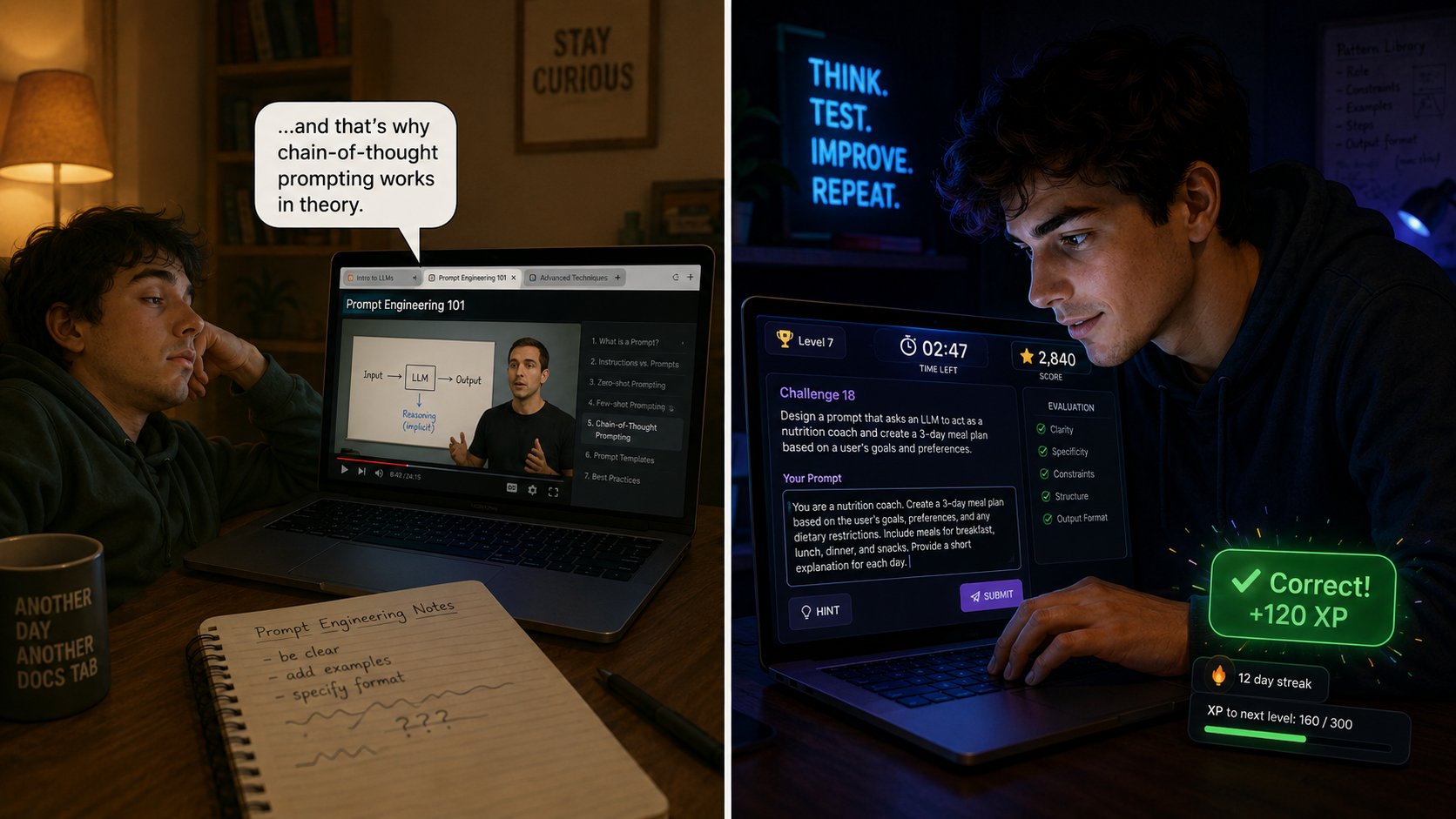
The problem wasn't the teachers. The problem was the format. Watching someone else prompt an AI is like watching someone else learn to ride a bike. You can follow the theory exactly and still fall off the moment you try it yourself because the skill lives in the feedback loop, not in the explanation.
I found RentPrompts AI Games by accident, clicking around the platform looking for something else. Two weeks later I'd developed more genuine prompt engineering instincts than I had in three months of tutorials. This is the story of why that happened and why gamified learning is rapidly becoming the most effective path into AI skills in 2026.
"Prompt engineering isn't a passing trend it's a core communication skill for the AI age. The people building that skill fastest aren't watching tutorials. They're playing games."
The Numbers That Put This in Context
| Stat | Detail |
|---|---|
| 200x | Increase in job postings requiring prompt engineering and generative AI skills in recent years — LinkedIn Talent Insights 2026 |
| #1 | Gamified AI learning identified as the fastest-growing application of educational technology in 2026 |
| 5 min | Average session length for gamified AI learning vs 47 minutes for video tutorial — and 5x higher daily return rate |
Why Tutorials Fail (And It's Not Your Fault)
Let me be specific about what doesn't work, because I spent three months doing it and I want to save you the same time.
Passive prompt engineering content fails for one structural reason: the feedback loop is broken. The tutorial explains a technique. You watch. You think you understand. You try it in a separate window. The output is mediocre. You don't know if the problem was your prompt, the model, the context, or something you didn't account for. So you watch another tutorial. The cycle repeats.
The fastest-growing application of gamification in 2026 is using it to teach people how to use AI. Marketers, analysts, and operators don't need another two-hour webinar on prompt engineering. They need short, repeatable practice on the judgment calls AI work actually requires: writing prompts that hold up, detecting quality outputs, and separating hype from substance.
That's the insight that makes AI Games on RentPrompts work. It doesn't explain prompt engineering. It puts you inside situations where you have to use it and gives you instant, specific feedback on whether what you did worked. The difference in learning velocity is not subtle.
What RentPrompts AI Games Actually Is
The AI Games section of RentPrompts is a gamified prompt engineering learning environment built into the same platform where you can generate images, explore a prompt marketplace, and access the AI Academy. It's not a separate app you have to find; it's part of a complete AI creative ecosystem.
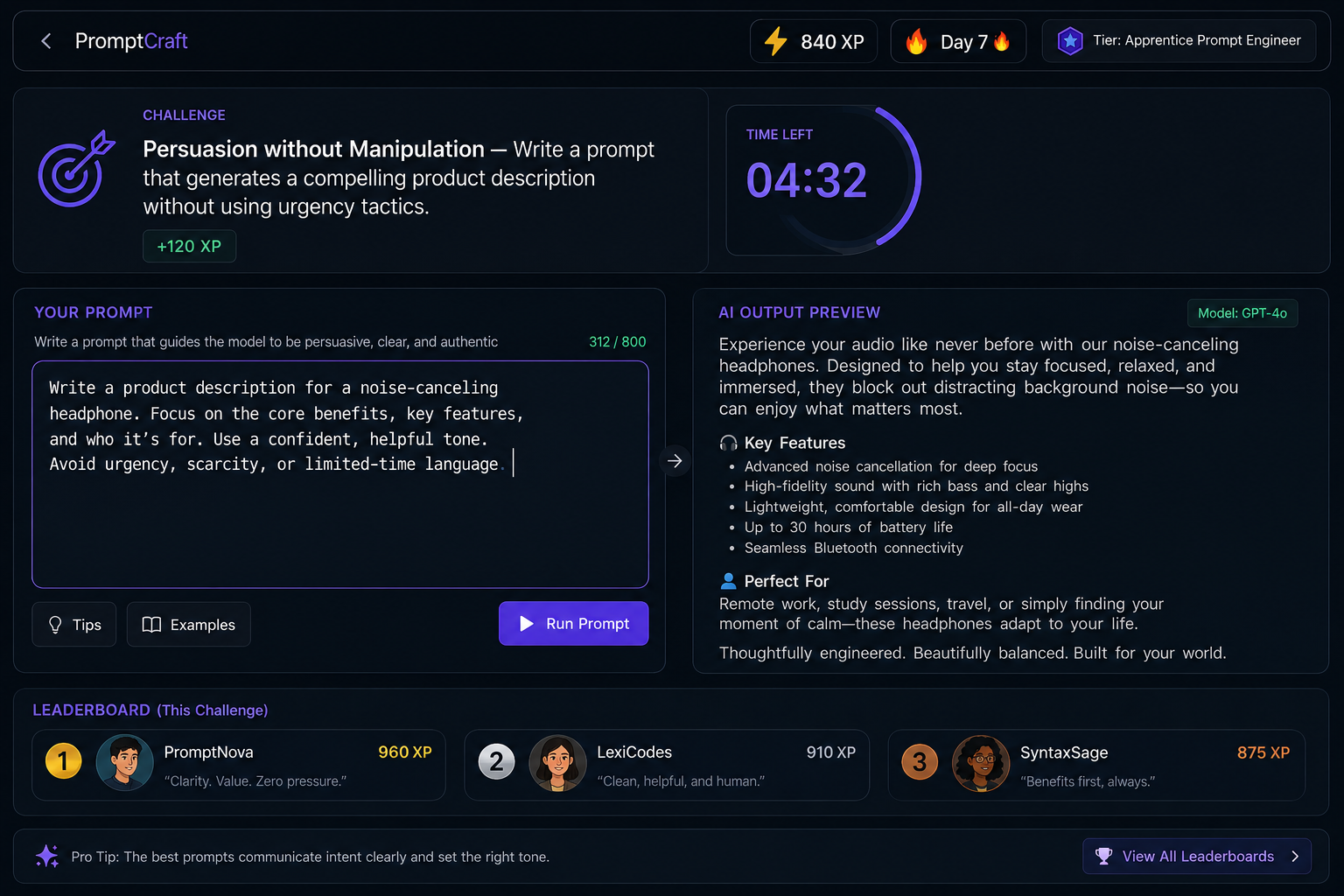
The core experience: you're given a challenge, a context, and a goal. You write a prompt. The AI runs it. The system evaluates the output against the target. You receive a score, feedback, and XP. The leaderboard updates. You try again.
That sequence — challenge → attempt → feedback → score → retry — is the complete learning loop that tutorials skip entirely. It's the same loop that made you good at every game you've ever learned. And it turns out it works just as well for building prompt engineering skills as it does for building any other skill.
The 4 Game Mechanics That Build Real Prompt Skills
Challenge Mode
Timed prompt challenges with specific output targets
Challenge Mode gives you a defined goal, producing an output that matches a target, achieves a quality threshold, or solves a creative problem and a time limit. The time constraint is deliberate. It stops you from overthinking and forces you to rely on instinct, which is exactly how you develop instinct. Every challenge is different. Every solution teaches you something specific about how the model responds to different prompt structures.
Leaderboard Competition
See where your prompts rank against other players
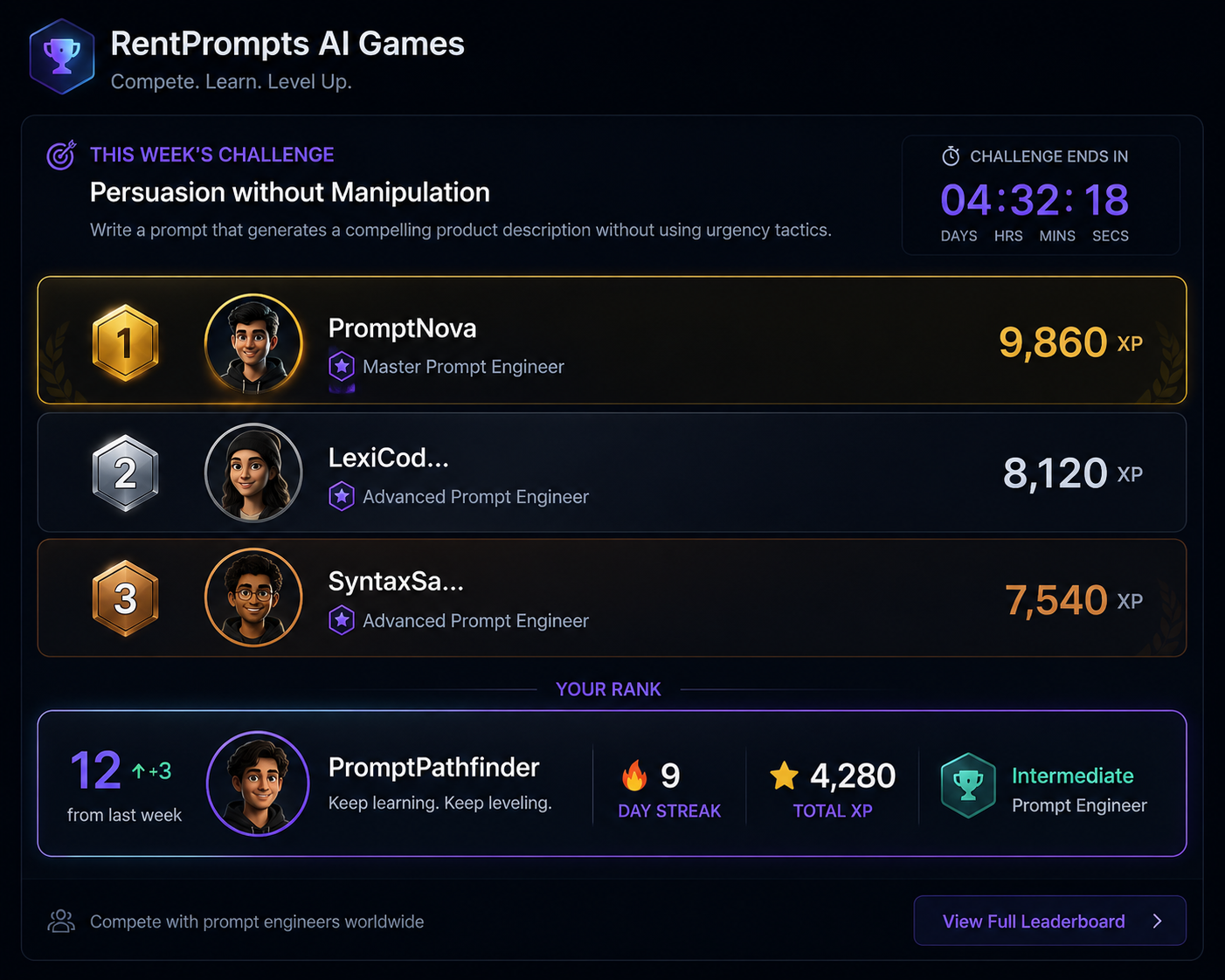
The leaderboard isn't just for ego. It's the mechanism that makes you care enough to improve. When you can see that someone else's prompt scored 94 and yours scored 71 on the same challenge, you naturally want to understand why. That curiosity is the engine of learning. Streaks, XP, and leaderboards keep people coming back daily not because they're addictive dark patterns, but because they make improvement visible and meaningful.
Instant Feedback Loop
Know immediately what worked and what didn't
This is the mechanic that tutorials simply cannot replicate. When your prompt runs and you see the output scored in real time with specific feedback about what the prompt achieved and where it fell short you build the intuition that makes a prompt engineer dangerous. The feedback loop closes in seconds rather than the days it takes to realize a technique you watched in a tutorial isn't actually working in your projects.
XP & Streak System
Progress that compounds daily
Every challenge completed builds XP. Every day you play maintains a streak. The streak system is based on the same learning science as language apps that have successfully taught millions of people to speak new languages. Daily short practice beats occasional marathon sessions by an enormous margin. Five minutes of active AI gaming builds more durable skill than forty-five minutes of passive tutorial watching.
The Skill Map: What Each Game Level Teaches You
Here's what the progression actually looks like: the prompt engineering skills you build at each stage of the game, from the first challenge to leaderboard competitor.
Level 1: Foundations (Beginner Challenges)
What you learn: How to give Claude or any AI model enough context to produce useful output. The difference between a vague instruction and a specific one. How tone, format, and length instructions change what comes back.
Real-world application: Writing better daily prompts for work task summaries, drafts, and research briefs that actually serve their purpose.
Level 2: Structure & Framing (Intermediate Challenges)
What you learn: Role assignment, few-shot examples, chain-of-thought instructions, output constraints. How to frame a prompt so the model produces structured, reusable output rather than a wall of text.
Real-world application: Building prompt templates for recurring workflows, content creation, analysis, decision support, and research pipelines.
Level 3: Advanced Technique (Expert Challenges)
What you learn: System-level prompting, persona engineering, context management across long sessions, handling edge cases and model tendencies. The subtle difference between prompts that produce adequate output and prompts that produce remarkable output.
Real-world application: Building AI-powered tools, automating complex workflows, creating prompt libraries that function as a professional knowledge asset.
Level 4: Challenge Mode Competition (Leaderboard)
What you learn: Speed, adaptability, and the ability to write effective prompts under constraints you didn't anticipate. The competitive environment surfaces techniques you'd never find in a tutorial because they emerge from real challenge conditions.
Real-world application: Every situation where you need to get the best possible output from AI quickly, like client work, deadlines, and live demonstrations.
💡 Why this progression matters: Most prompt engineering resources teach you the vocabulary before you have the experience to understand it. The game-based progression at RentPrompts works in reverse you develop the experience and instinct first, then the vocabulary to describe what you've learned starts making sense. This is how humans actually build skill. It's how you learned to ride a bike, to cook, to drive. Theory after practice, not before.
Who Learns Best From AI Games (It's Not Who You Think)
Working Professionals With No Time
You have 10 minutes between meetings. A tutorial requires 40 minutes of focused attention and a notepad. A prompt engineering challenge requires 10 minutes and produces an immediate result you can feel. The game format was designed for exactly this reality.
Students Who've Tried Courses and Quit
Companies like OpenAI, Anthropic, Google DeepMind, and Accenture are actively hiring prompt engineers to fine-tune enterprise workflows and train AI assistants. If you've tried to break into this field through conventional courses and stalled, the game-based format often unlocks something that passive learning never could. The immediate feedback loop is particularly valuable for people who learn by doing.
Developers Who Already Know the Theory
You've read the documentation. You understand the concepts. You can't consistently produce the outputs you want. The challenge mode pressure-tests your theoretical knowledge against real output goals and shows you precisely where your mental model is wrong.
Creative Professionals Entering AI Workflows
Writers, designers, marketers, and creators who need prompt engineering as a professional tool but find technical tutorials alienating. The game format meets you where you are — no prior technical knowledge required, just curiosity and willingness to play.
Absolute Beginners Starting From Zero
AI-gamified learning personalizes the journey for each learner, assessing where someone excels and where they struggle, then adjusting difficulty to keep them on track without frustration or boredom while providing consistent feedback. If you've never written a prompt in your life, the beginner challenges at RentPrompts AI Games start exactly where you are and build progressively.
How RentPrompts AI Games Fits Into the Bigger Platform
This is worth understanding because it changes how you think about your learning investment. RentPrompts AI Games isn't a standalone product; it's one layer of a complete AI creative and learning ecosystem.
The skills you build in the games immediately plug into everything else on the platform:
- AI Prompt Marketplace: the better you understand what makes a prompt work, the better you can evaluate, use, and create prompts worth selling
- AI Generation Tools: Flux, Gemini 2.5, Veo 3. Your prompting skill directly determines the quality of what you generate
- AI Academy: structured learning that layers on top of the instinct you've built through games
- AI Bounties: real paid challenges where prompt engineering skill translates directly into income
- AI Apps (Rapps): tools that require prompt literacy to get the best results
The game teaches you to fish. The rest of the platform is the ocean.
The Science Behind Why This Works
Gamified learning brings the structure of games into education, creating experiences where learners earn rewards, track progress, and actively participate, adding an element of excitement to learning that traditional methods often can't match.
But beyond the excitement, there's a specific neuroscience reason why game-based learning produces durable skills: variable reward and immediate feedback.
When you attempt a prompt challenge and get an instant score, your brain processes that outcome differently than it processes information from a tutorial. The attempt-result cycle triggers the same learning consolidation that makes any skill stick whether it's a tennis stroke, a chess opening, or a musical scale. You don't just know the information. You own it.
Traditional prompt engineering education skips this step entirely. You're given theory without the practice repetitions that convert theory into instinct. The RentPrompts AI Games format is built entirely around those repetitions, which is why two weeks of active play can outpace three months of passive tutorial consumption.
Getting Started: Your First Week on AI Games
If you're starting from zero, here's exactly how to structure your first week to build momentum:
| Day | Focus | Time |
|---|---|---|
| Day 1 | Complete your first 3 beginner challenges. Don't worry about score — focus on understanding how feedback works. | 15 min |
| Day 2 | Replay your Day 1 challenges with different prompt approaches. Compare scores. Notice what changed. | 10 min |
| Day 3 | Try your first intermediate challenge. Fail intentionally — try a prompt you don't think will work. Learn from the score. | 15 min |
| Day 4 | Check the leaderboard. Find the top scorer on a challenge you've completed. Think about what their approach might have been. | 10 min |
| Day 5 | Complete 5 challenges across different categories. Build breadth before going deep. | 20 min |
| Day 6 | Return to your lowest-scoring challenge. Apply what you've learned. See if you can beat your own score. | 10 min |
| Day 7 | Attempt your first Challenge Mode. Use everything you've built. Check your leaderboard rank. | 15 min |
Total time: ~95 minutes across 7 days. Less than two standard tutorial videos. More durable skill than most people build in a month of passive learning.
Frequently Asked Questions
Do I need to know anything about AI before playing?
Nothing at all. The beginner challenges at RentPrompts AI Games start from the absolute foundation: what a prompt is, how to structure one, and what different types of instructions do. If you've ever typed a question into a search engine, you have enough background to start.
What AI models are used in the challenges?
RentPrompts uses leading models including Claude, Gemini, and others depending on the challenge type. Part of what the games teach is how to write prompts that work across different models, a more valuable skill than model-specific optimization.
How does the leaderboard work?
Scores are calculated based on how closely your prompt's output matches the challenge target, evaluated across multiple dimensions: accuracy, format, tone, and output quality. The leaderboard resets periodically so there's always a fresh competitive window for new players.
Can I use what I learn in the games professionally?
Immediately and directly. Every technique the challenges teach maps to real professional applications from content creation and research automation to customer service scripts and data analysis workflows. The AI Bounties on RentPrompts are a direct bridge from game skill to paid work.
Is this different from the RentPrompts AI Academy?
Complementary, not competing. The AI Academy provides structured curriculum and conceptual depth. AI Games provides the hands-on practice repetitions that make the curriculum stick. The best learning path uses both games to build instinct and the academy to build understanding.
What other ways can I learn and create on RentPrompts?
Beyond games and the Academy, you can explore the AI Prompt Marketplace to study high-performing prompts, use generation tools to practice in real creative contexts, and access AI Apps that put your prompt skills to immediate aesthetic use.
What Happened After Two Weeks of Playing
I closed those seventeen browser tabs.
Not because I stopped being curious about prompt engineering, but because I stopped needing tutorials to learn it. The game feedback loop had replaced the passive consumption loop. I was building skill through attempt and failure and refinement, which is the only way skill actually gets built.
By the end of week two, I was writing prompts that worked the first time more often than not. My AI-generated content for work improved noticeably. I started seeing the leaderboard scores as a genuine benchmark rather than an arbitrary number because I understood what the difference between a 70 and a 95 actually felt like in the output.
The tutorials were right about the theory. The game taught me how to use it.
That's the distinction that matters in 2026: knowing what prompt engineering is versus being able to do it under pressure, for any goal, on any model, consistently.
The game is how you get from the first thing to the second.
Start Playing - Learn Prompt Engineering Today
Challenge Mode · Leaderboards · XP System · Real Skill, Real Fast
Explore the Full RentPrompts Platform.
- → AI Games — gamified prompt engineering challenges, leaderboards, and XP
- → AI Academy — structured learning curriculum for every AI skill level
- → AI Prompt Marketplace — thousands of curated prompts across every category
- → AI Bounties — get paid for your prompt engineering skill
- → Generate with Flux, Gemini & Veo 3 — put your prompt skills to work in real creation
- → AI Apps (Rapps) — AI-powered tools that reward prompt literacy
- → Community — connect with prompt engineers, creators, and AI learners
- → RentPrompts Blog — more stories at the intersection of AI, learning, and creativity
- → Plans & Pricing — start free, scale when you're ready
0 Comments

No comments yet. Be the first to start the discussion!