My grandmother had a book. Old, cloth-bound pages the color of milky tea. Inside were plates of botanical illustrations from a Victorian scientific atlas that I spent hours studying as a child. The detail was almost incomprehensible: a single leaf rendered with hundreds of fine ink lines, every vein labeled in neat italic script, inset studies showing cross-sections and root structures in corners framed by hair-thin borders. The name at the bottom of each plate was always the same engraver's mark. Someone had given years of their life to these images.
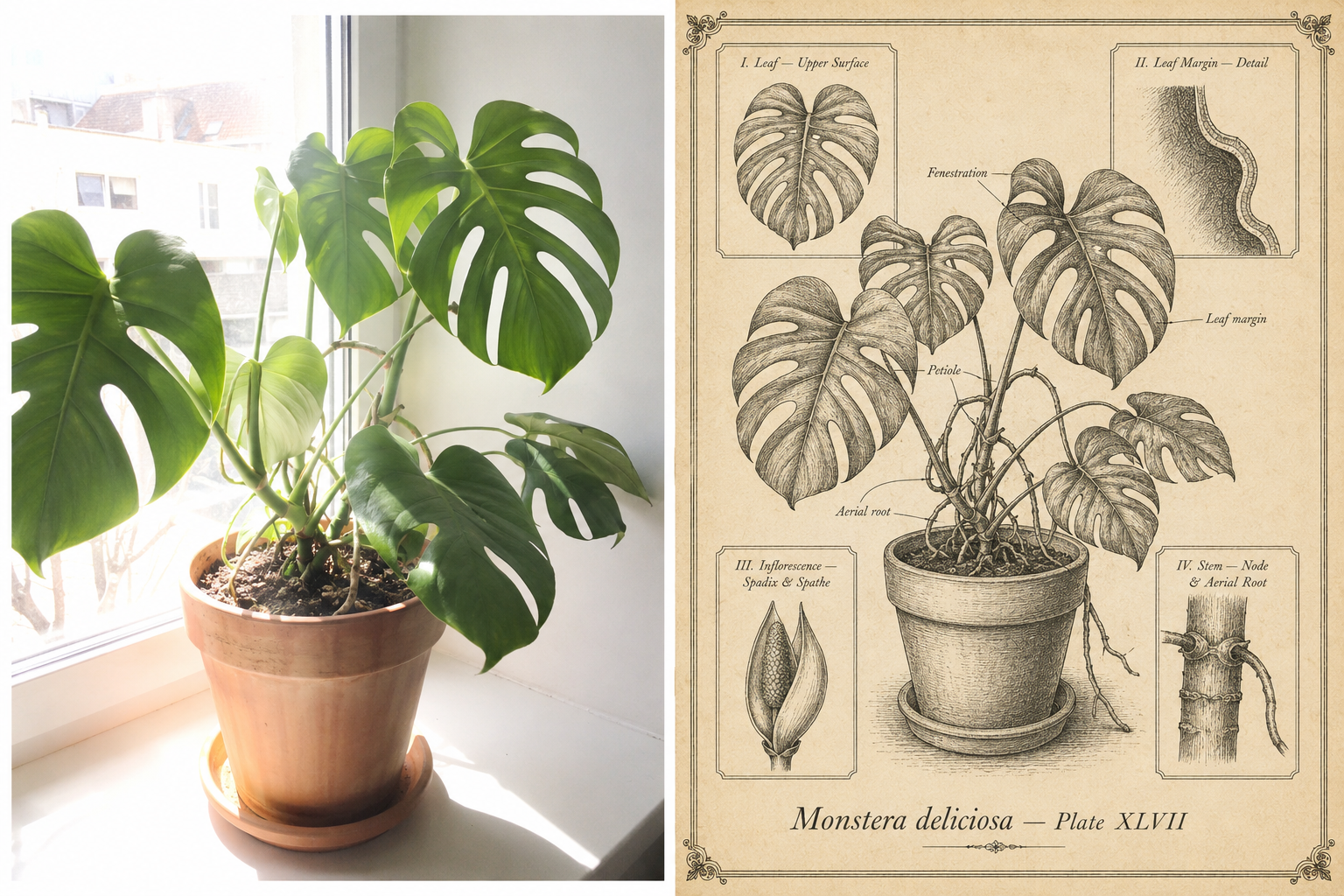
I thought about that book when I uploaded a photo of my monstera into the
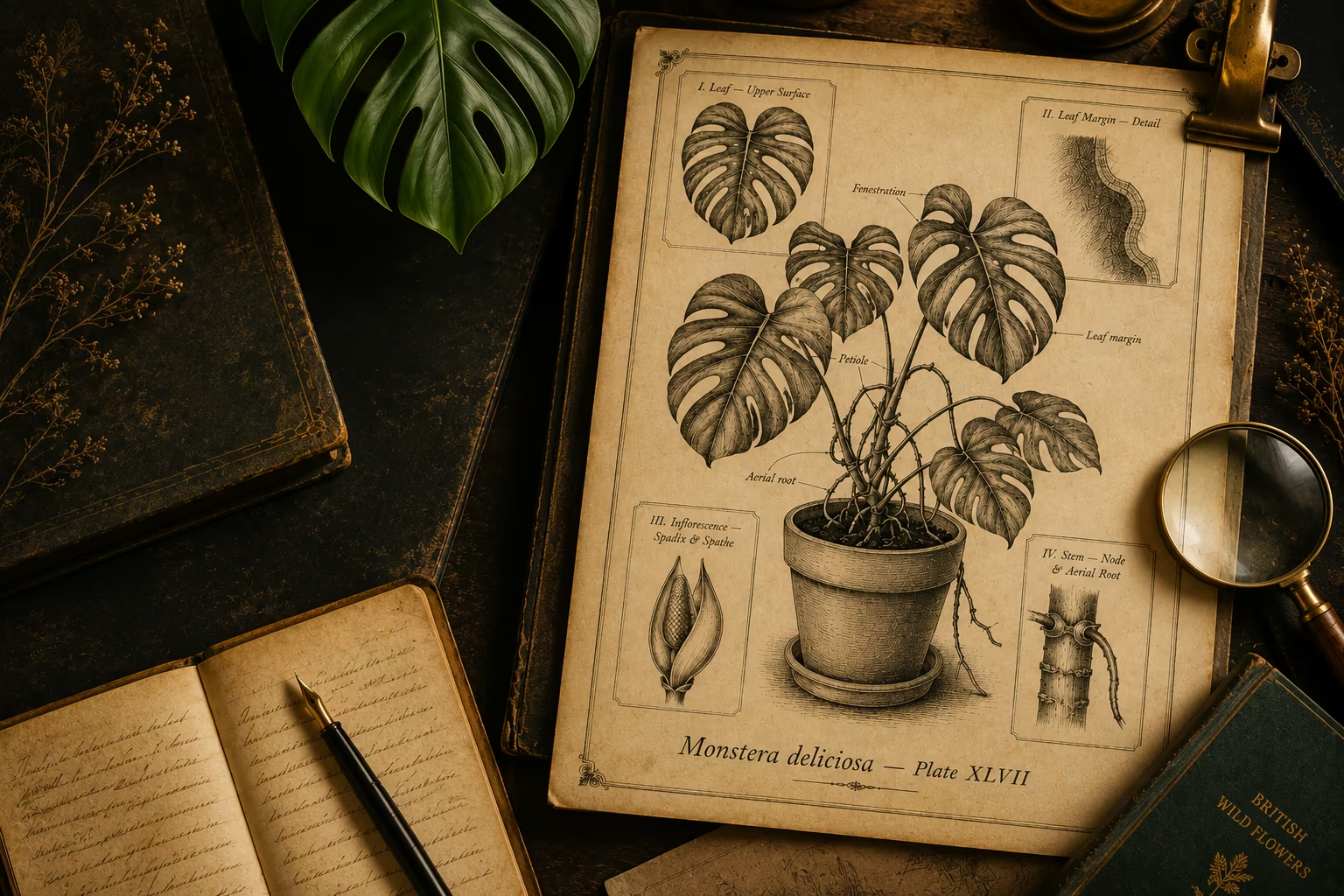
Vintage Botanical Illustration Poster tool on RentPrompts last month. Because what came back, the fine linework, the cross-hatching, the annotated callouts, and the central illustration surrounded by inset studies, looked like it could have come from that book. Not a filter. Not a watercolor overlay. A genuine 19th-century scientific atlas plate, generated from a single modern photograph in under sixty seconds.
This is the story of what that tool is, where it comes from historically, and why designers, educators, and creators in 2026 are rediscovering the visual language of Victorian botanical science as one of the most resonant aesthetics of the moment.
"Before photography, a botanical illustrator was the most important person on a scientific expedition. Everything discovered depended on what they could render with ink and a steady hand." — The History of Scientific Illustration
The Lost Art That Never Should Have Been Lost
Between roughly 1820 and 1900, scientific botanical illustration reached a peak of technical refinement that has never been matched. The great European natural history expeditions to the tropics, to the Americas, and to the Pacific returned with specimens that needed to be documented with absolute precision. Photography didn't yet exist in a form suitable for scientific recording. Everything depended on the illustrator's eye and hand.
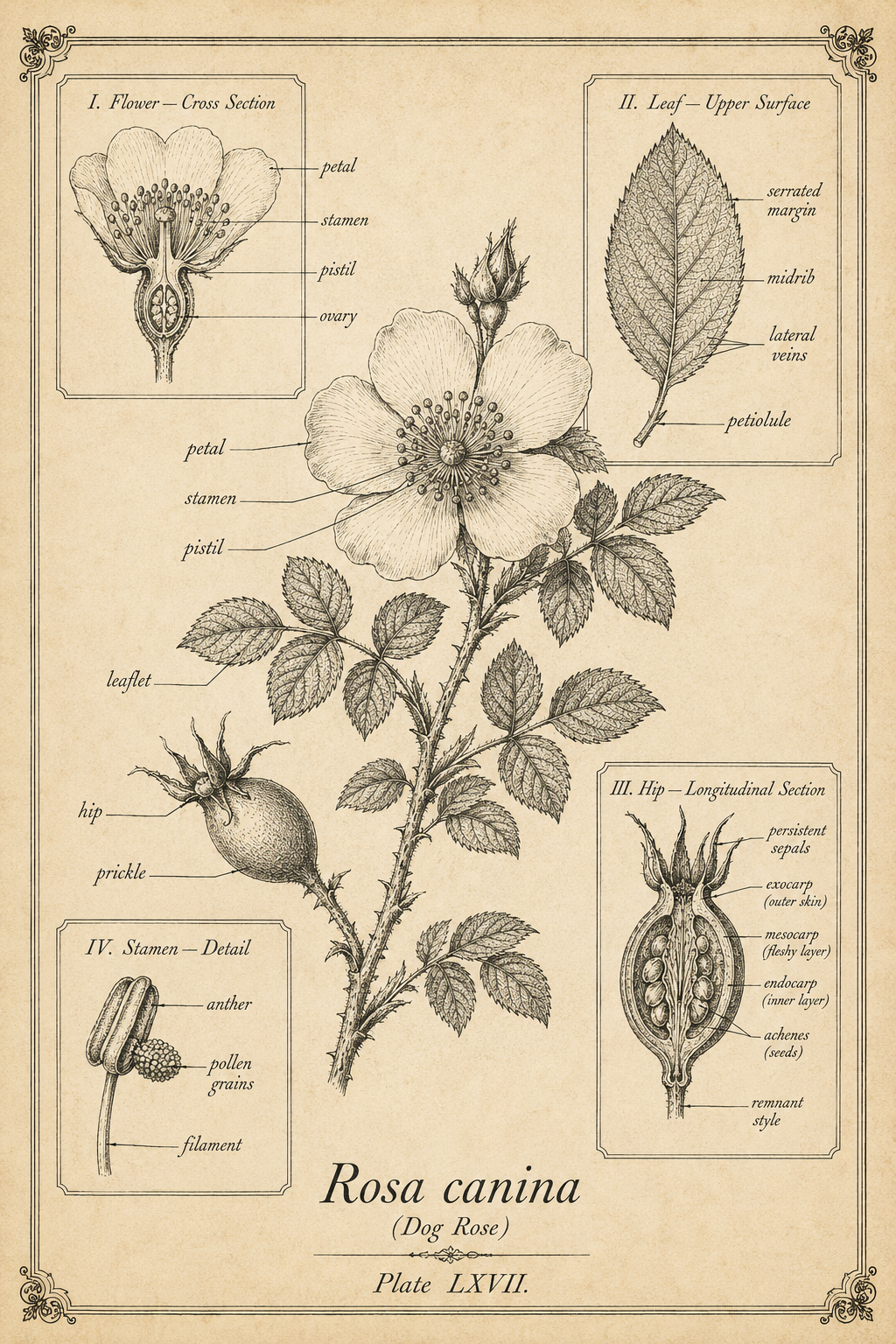
The style that emerged was distinctive: a central main illustration showing the complete plant, surrounded by inset studies of individual elements, flower cross-sections, root structures, seed pods, and leaf venation patterns. Every part was labeled with careful italic script, often in Latin. Fine linework defined the outer edges; cross-hatching built up shadow and form. The composition was both a scientific document and a work of art.
Artists like Franz Bauer, Georg Dionysius Ehret, and Sydney Parkinson (who documented Joseph Banks' collections from Captain Cook's first voyage) produced illustrations of such extraordinary quality that they remain in active scientific use today. The plates from Curtis's Botanical Magazine, published continuously from 1787, are still referenced by botanists.
When photography became viable for scientific documentation in the early 20th century, the era of the botanical illustrator gradually ended. The style was preserved in museum archives, antique print shops, and the occasional reproduction book. For most of the past century, producing new work in this visual language required years of specialist training and hand skills that almost nobody learns anymore.
Until now.
What the AI Actually Creates - Feature by Feature
The
RentPrompts Vintage Botanical Illustration Poster doesn't apply a sepia filter or add a border to a photograph. It understands the visual grammar of 19th-century scientific illustration and reconstructs it from your uploaded image. Here's what the output contains:
Fine Linework & Cross-Hatching
The defining technique of Victorian scientific engraving
Every element of your subject is rendered in pure ink-style linework, fine, controlled strokes that define edges, and graduated cross-hatching that builds form and shadow the way a copper engraver would have done it in 1850. No photographic texture. No color wash. Pure line and mark, the way the original illustrators worked.
Annotated Diagram Callouts
Labels and callout lines in plain English
The AI identifies key structural elements of your subject and generates labeled callout lines, the kind that point from a label to a specific feature of the illustration. Written in plain English (not Latin, unless you prefer it), these give every output the character of a genuine scientific document. This is what separates the RentPrompts tool from any simple art-style filter.
Inset Studies & Structural Analysis
The atlas plate composition in full
Authentic 19th-century botanical atlas plates always included multiple inset studies: small, bordered frames showing details that couldn't be seen in the central illustration: a cross-section here, a magnified element there. The AI generates these inset studies automatically, creating a complete atlas plate composition rather than a single large illustration.
Central Illustration Composition
Museum-quality layout on aged paper ground
The overall composition, central illustration, surrounding insets, decorative border, title block with Latin binomial, and plate reference at the bottom follow the exact layout conventions of the great 19th-century atlases. The output looks like it was pulled from a shelf in a natural history museum archive. Because it was designed, in every detail, to look exactly like that.
How to Create Your Botanical Atlas Plate in 4 Steps
The tool is designed for every level of creator, from professional designers who need print-ready art to curious beginners who just want to see what their garden looks like through Victorian eyes.
- Photograph your subject in good light. Plants, flowers, leaves, herbs, trees, and anything botanical or natural. Clear, well-lit photographs produce the most detailed linework. The AI needs to see the structure of your subject clearly to render it accurately.
- Upload to the Vintage Botanical Illustration Poster tool. The interface is clean, and you immediately upload your image, and the AI begins constructing your botanical plate. No style settings to configure. The 19th-century atlas aesthetic is built into the tool's entire output pipeline.
- The AI generates your complete atlas plate. Central illustration in ink linework and cross-hatching. Labeled callout lines. Inset detail studies. Title block with botanical naming. Decorative border. The full composition is in one output, not a template you fill in, but a genuinely generated illustration.
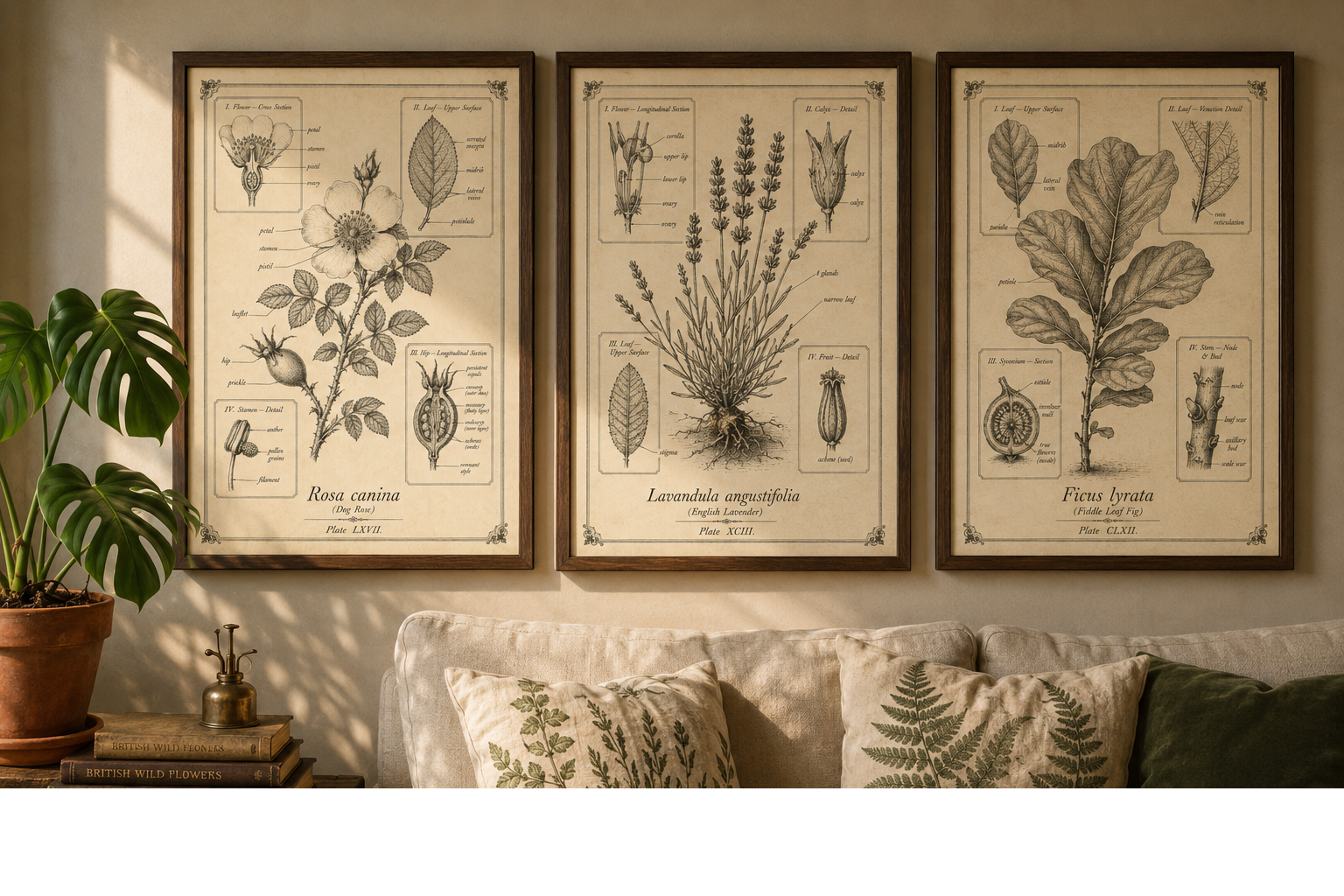
- Download and use anywhere. Print it as wall art. Use it in an editorial layout. Post it as content. Sell it as a digital product. Frame it. The output is poster-quality resolution designed for print, not just screens.
What works beyond houseplants: The tool's atlas-style composition works beautifully on any natural or organic subject — wildflowers, herbs and spices, fruit and vegetables, garden specimens, even mushrooms and fungi. If it grows or was once living, the Victorian scientific illustrators would have documented it, and this tool will render it in that tradition. Try uploading a simple sprig of rosemary or a single oak leaf and see what the AI finds in the detail.
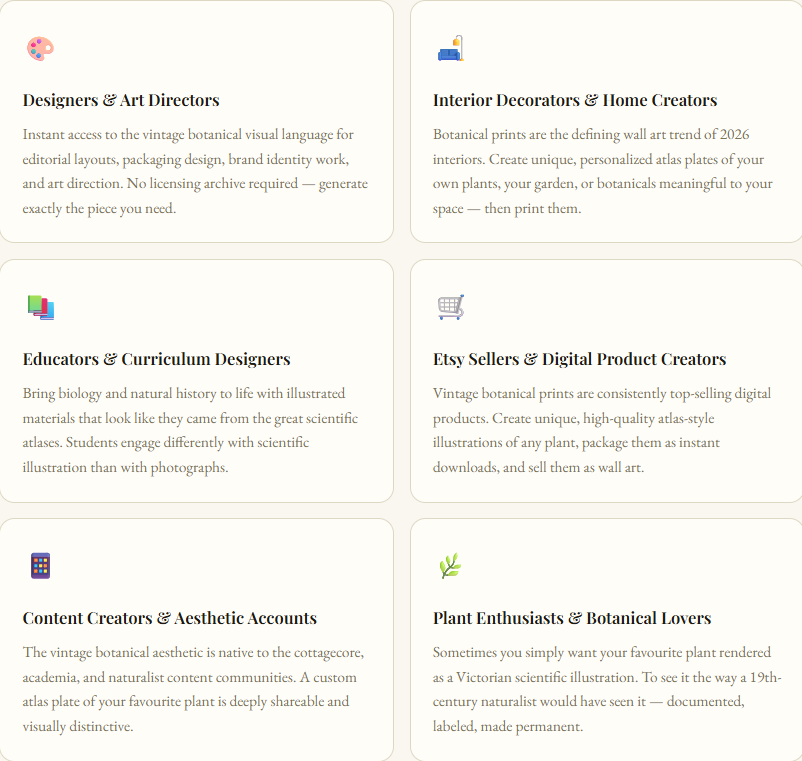
Who Creates With This - And What They Make
 Why This Visual Language Is Having Its Moment Right Now
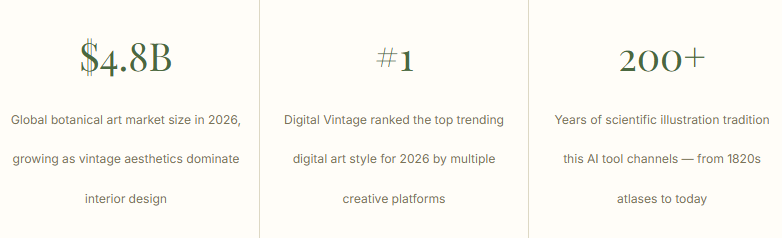
The resurgence of botanical illustration aesthetics in 2026 isn't accidental. Digital Vintage has been named the top trending digital art style of the year by multiple creative platforms, and botanical illustration sits at the precise intersection of the cultural forces driving that trend.
There's a hunger for things that feel considered and handmade for craft and detail and the evidence of human attention, even in a digital world. Victorian botanical illustration is the ultimate expression of that: every line placed with intention, every label serving a purpose, the entire image constructed as an act of careful observation. In an era of instant filters and AI-generated everything, something that looks like it required weeks of patient skill carries genuine weight.
And there's the nostalgia dimension. Cottagecore, academia, naturalism, and vintage scientific aesthetics: these communities have been growing across every major platform for three years. The vintage botanical atlas plate is their visual ideal: beautiful, educational, historically grounded, and deeply aesthetic all at once.
The
RentPrompts tool doesn't make that aesthetic accessible by approximating it. It reconstructs it, with the linework, the composition, the callout conventions, and the aged paper ground, with genuine fidelity to the source material. That's why the output looks like something from a museum archive, not something that looks vaguely old.
Frequently Asked Questions
What subjects work best with the Vintage Botanical Illustration Poster tool?
Any botanical or natural subject produces beautiful results: houseplants, garden flowers, wildflowers, herbs, fruit and vegetables, mushrooms, ferns, and trees. Clear, well-lit photographs of single subjects tend to produce the most detailed outputs.
Can I print and sell the illustrations I generate?
Yes, content generated through RentPrompts. AI apps can be used for commercial purposes, including digital products and print sales. The poster-quality resolution of the output is designed for print. Check the
RentPrompts terms for full commercial usage details.
Do the callout labels use Latin or plain English?
The tool generates annotated labels in plain English by default, identifying real structural features of your subject. The Latin binomial naming follows authentic 19th-century convention in the title block.
What resolution is the output?
The output is generated at poster-quality resolution, suitable for printing at standard wall art sizes. Visit the
tool page for current format specifications.
I'm not an artist or designer. Can I still use this tool effectively?
Completely, the entire visual complexity is handled by the AI. You photograph your subject, upload it, and receive a finished museum-quality plate. No illustration skills, no design software, and no understanding of Victorian engraving technique are required.
What other AI creative tools does RentPrompts offer?
What My Grandmother's Book Made Me Understand
I went looking for that old botanical atlas after my first output from the RentPrompts tool. It took me twenty minutes to find it on the shelf, a cloth cover, slightly warped from age. I opened it to the plate I remembered best. A Rosa canina. Hundreds of fine ink lines. Four inset studies. The engraver's mark is at the bottom right corner.
I placed my phone next to it, showing the atlas plate the tool had generated from a photograph of my garden rose. My partner looked at both and asked which one was older.
That question is the whole point. The visual language of 19th-century scientific illustration was never obsolete, it was just inaccessible. It required skills, training, and time that almost nobody has. What the RentPrompts tool does is make that language speakable again, by anyone with a photograph and something worth documenting.
Your plant deserves a plate. Your garden deserves an atlas. And somewhere, a Victorian scientific illustrator who gave years of their life to rendering the natural world in ink might find something like satisfaction in knowing the tradition carries on.
Available Now on RentPrompts
Turn Your Plant Into a Museum Piece
Upload any image and receive a complete 19th-century scientific atlas illustration fine linework, annotated callouts, inset studies. Museum quality. Generated in seconds.
Fine Linework · Cross-Hatching · Annotated Callouts · Inset Studies · Atlas Composition
Explore More on RentPrompts