
Featured insight
The ₹50,000 Mistake That Changed How I Handle Client Briefs Forever

sakshi.__
April 11, 2026•7 min read
#casestudy
The ₹50,000 Mistake That Changed How I Handle Client Briefs Forever
"Just make it look good." — The 4 words that cost me everything.
Rohan had been freelancing for 2 years. He was good at what he did — logos, websites, social media creatives. Clients loved his work. His portfolio was clean. His rates were fair.
But one Tuesday evening, a client sent him a message that would change everything.
"Hey Rohan! Need a website for my new business. Just make it look good. Budget is flexible. Let's do this!"
Rohan smiled. Easy money, he thought.
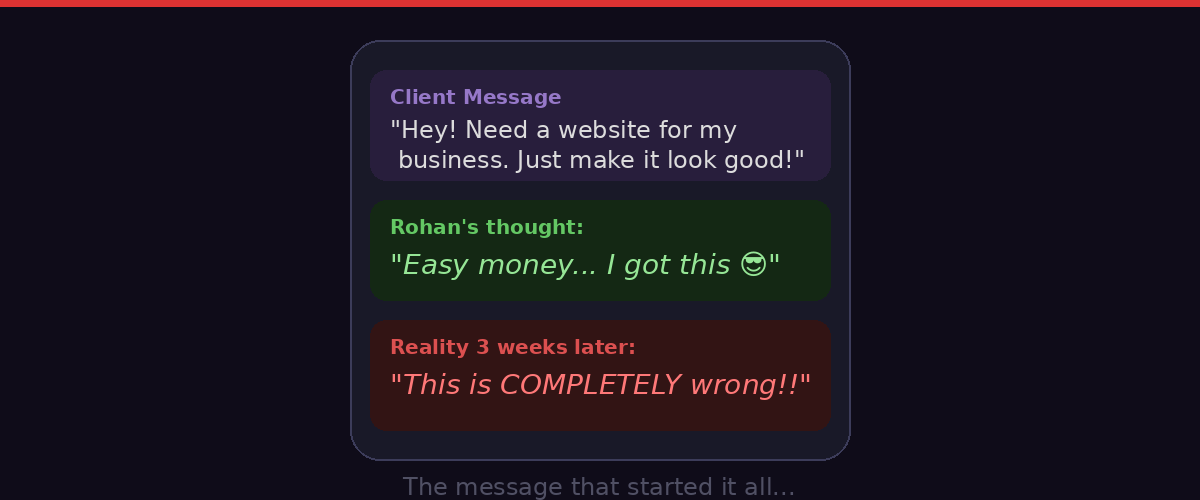
The message that started it all — four words, no brief, no direction.
The Disaster Nobody Warned Him About
He spent 3 weeks building a sleek, modern website. Dark theme. Smooth animations. Mobile-friendly. He was proud of it.
Then he sent it to the client. The reply came in 4 minutes.
"This is completely wrong. I wanted something colorful and traditional. My customers are 50+ year old women in small towns. Why does this look like a tech startup??"
Rohan stared at the screen. His stomach sank.
He had built exactly what he imagined — not what the client needed. And the worst part? The client had never clearly said what they wanted. And Rohan had never asked.
3 weeks of work. Wasted. The client demanded a full redo — for free. Rohan lost ₹50,000 worth of time.
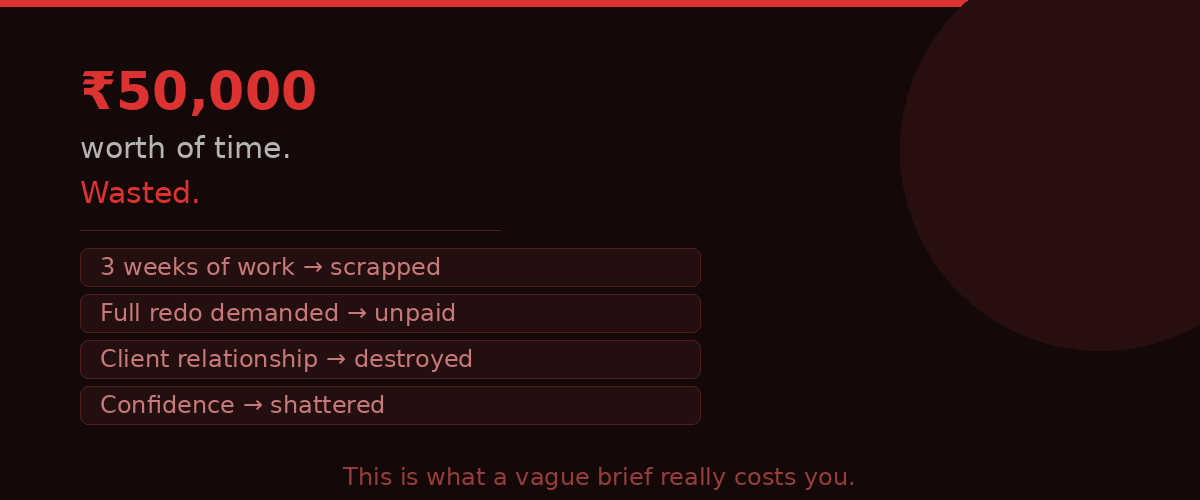
What a vague brief really costs a freelancer — beyond just money.
Why This Keeps Happening to Freelancers
Here's the truth about freelancing that nobody tells you: the brief is where projects die.
Clients don't know how to explain what they want. They say things like:
- "Make it pop"
- "Something modern but also classic"
- "You know what I mean, right?"
And freelancers — desperate to seem professional and just get started — nod along and say "Sure, I got it."
This happens because clients think in feelings and outcomes. Freelancers need specifications and constraints. Nobody teaches either side how to bridge that gap.
The result? Both sides are frustrated. The client feels unheard. The freelancer feels blindsided. And the project suffers.
What a Strong Brief Actually Covers
A good brief isn't a formality — it's the foundation of every successful project. Before starting any work, these six things must be clear:
1. Who is the audience? Not "everyone." Real demographics — age, location, income level, digital comfort. Rohan's client had 50+ women in small towns. That single fact changes font choices, color palettes, layout density, and copy tone entirely.
2. What does success look like? More calls? More sales? More trust? A freelancer designing for aesthetics while the client measures leads will always end in conflict. Align on this first.
3. What are three references you love — and why? References beat adjectives every time. "Warm but professional" is vague. A competitor's homepage is specific. Always ask for examples.
4. What do you absolutely not want? Clients often know their dislikes better than their preferences. Asking this question eliminates entire categories of wrong directions before you start.
5. What are the deliverables and revision policy? Scope creep kills freelance projects silently. Define what is included — and what isn't — before a single pixel is placed or word is written.
6. Who has final approval and what is the timeline? Surprise decision-makers and delayed feedback are two of the most common reasons projects run over budget. Know this upfront.
If you ask these six questions before every project, you will avoid 80% of the disasters that plague most freelancers.
The Night Everything Changed
3 months after the disaster, Rohan was sitting at his desk at midnight. Another vague brief had just landed in his inbox.
"Need content for my coaching business. Motivational. Professional. But also fun. Target audience is everyone."
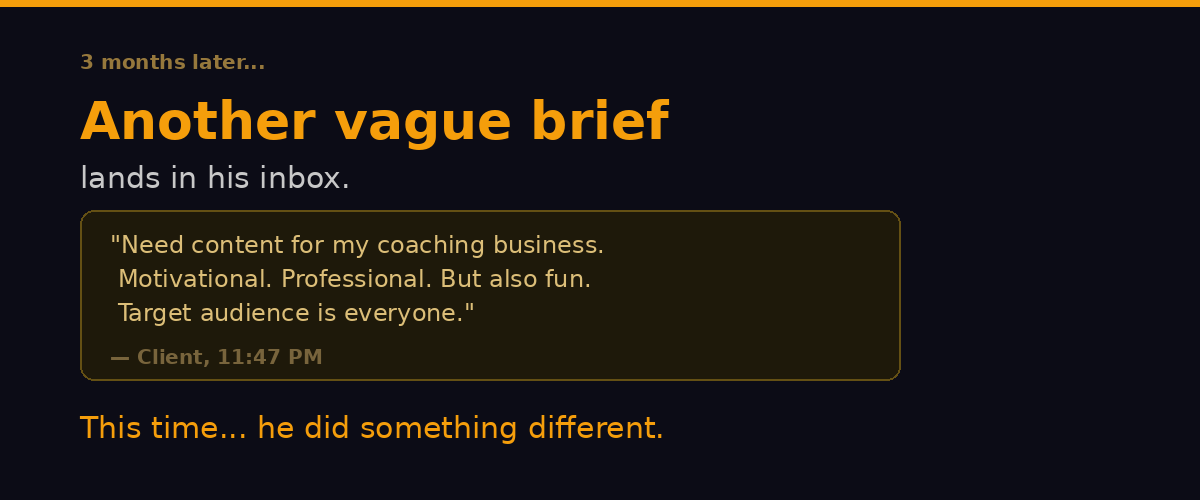
Another brief. Same red flags. "Target audience is everyone" is never an answer.
He groaned. He'd been here before.
This time, instead of guessing, he built a structured brief from scratch. He identified every missing piece of information. He drafted a professional email asking the right questions. He flagged "target audience is everyone" as an immediate red flag that needed clarification before any work began.
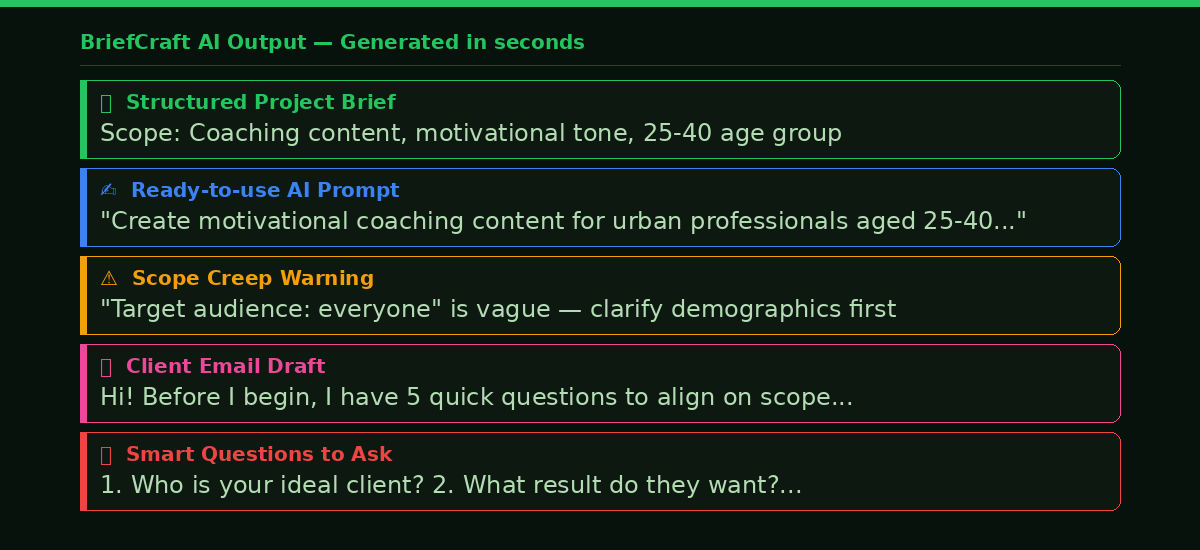
An example of a structured brief — scope, audience, warnings, and smart questions, all before work begins.
The process took 20 minutes. But it saved weeks.
What Happened Next
He sent the structured brief and questions to the client.
The client replied: "Oh wow, nobody has ever been this organized with me before. I'm impressed already."
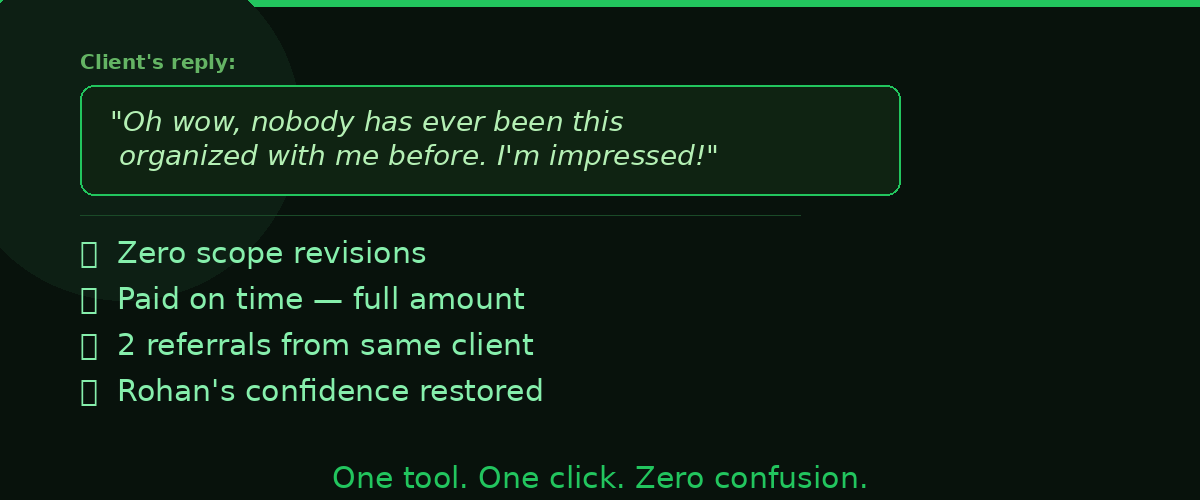
The outcome of asking the right questions first.
The project ran smoothly. Zero revisions on scope. The client paid on time — and referred two more clients.
The Real Skill Nobody Talks About
Asking good questions is a professional skill. It signals confidence, not uncertainty. Clients don't lose trust when you ask for clarity — they lose trust when you deliver the wrong thing after promising you understood.
The freelancers who consistently earn referrals, repeat clients, and on-time payments are rarely the most talented. They are the most organized. They ask before they assume. They document before they deliver.
Here is a simple checklist you can use before starting any project:
- Do I know exactly who the end user is?
- Do I know what success looks like to this client?
- Do I have at least 3 visual or written references?
- Have I confirmed what is NOT wanted?
- Have I defined deliverables and revision limits in writing?
- Do I know the timeline and who has final approval?
If any of these are unchecked, the project is not ready to start.
The Takeaway
Rohan's ₹50,000 mistake wasn't about bad design. It was about a missing conversation.
Every freelancer will face vague briefs. The ones who thrive are the ones who've built a system for handling them — a personal checklist, a template, or a structured process they follow every time.
The habit matters more than the tool. Ask before you assume. Clarify before you create. Structure before you start.
That's what separates a one-time freelancer from a long-term professional.
Have you ever lost time or money to a vague brief? What's your system for handling it? Tools like BriefCraft AI on RentPrompts can help automate this process — but the questions above work just as well on their own.
0 Comments

No comments yet. Be the first to start the discussion!