
Featured insight
What AI Tools Can (and Can’t) Do for Your Business

diptipawar1021
September 25, 2025•5 min read
#learning
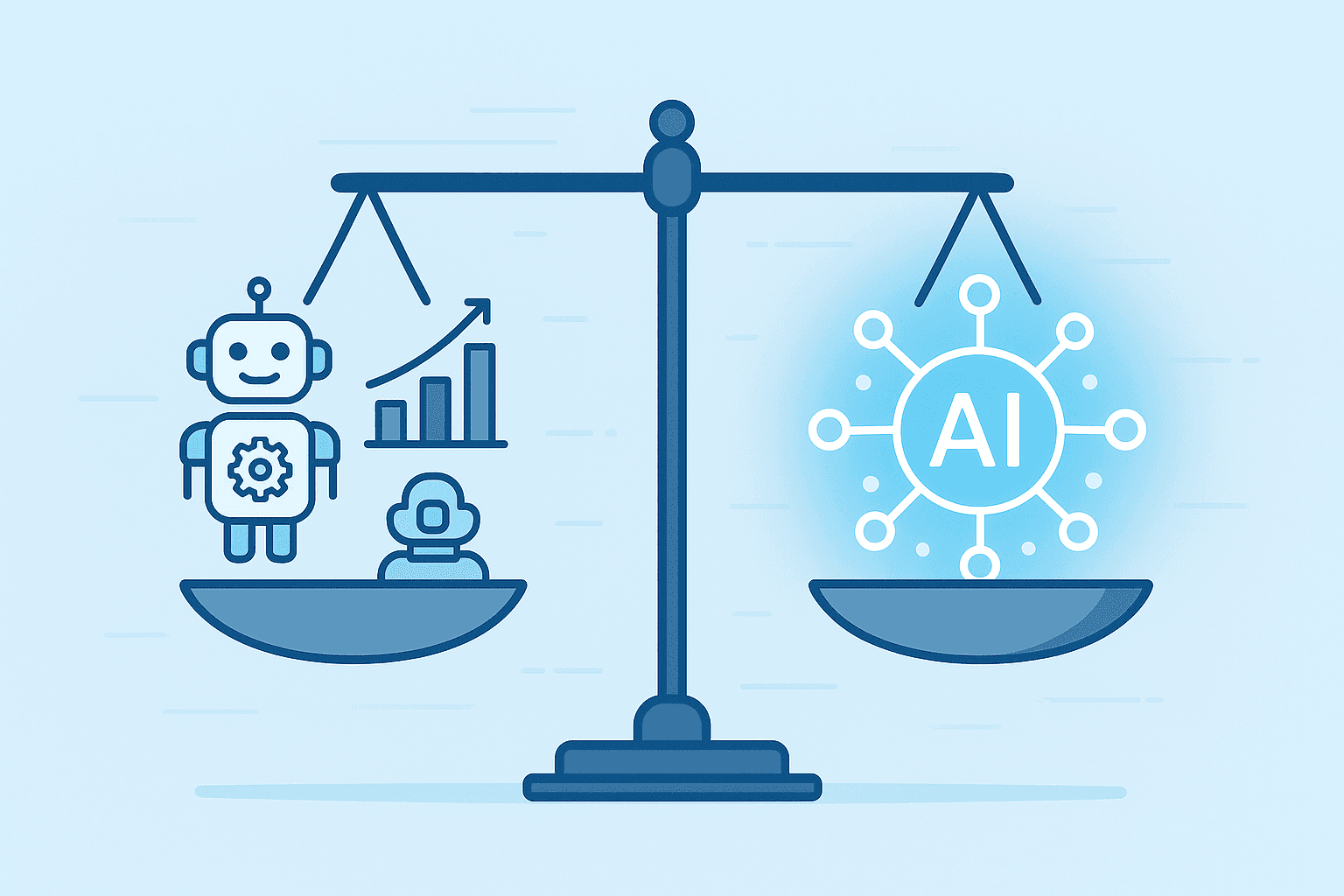
Over the past few years, businesses across industries have experimented with AI tools—chatbots for customer queries, sentiment analysis dashboards, and task automation bots. These tools deliver value, no doubt. They reduce manual effort, speed up processes, and create efficiency.
But here’s the reality: AI tools can only take you so far.
To truly transform business operations, organizations need to understand both what AI tools do well and where they fall short.
What AI Tools Can Do
- Automate repetitive tasks
- AI tools excel at handling structured, repetitive tasks.
- Example: Chatbots managing FAQs, AI transcription tools converting speech to text.
- Enhance productivity
- Tools like AI writing assistants or design generators help employees work faster.
- They don’t replace human creativity but accelerate workflows.
- Provide data-driven insights
- AI analytics tools process vast amounts of data to spot trends.
- Example: Customer segmentation, churn prediction dashboards.
- Improve customer engagement
- Chatbots, recommendation engines, and personalized emails increase customer satisfaction.
What AI Tools Can’t Do
- Break data silos
- Tools usually focus on a single function. Your marketing AI doesn’t automatically talk to your finance AI.
- Scale across departments
- An isolated chatbot helps support but doesn’t optimize sales or product development.
- Deliver holistic intelligence
- Without integration, you end up with fragmented insights rather than a unified strategy.
- Continuously adapt to change
- Most AI tools are rule-bound or narrow in scope; they don’t evolve unless built into a larger system.
Why This Gap Exists
Think of AI tools as apps on your phone. Each app does its job well, but unless they are connected in an ecosystem (like Google or Apple services), the experience remains fragmented.
That’s why businesses are now moving from AI tools toward AI ecosystems—where automation, data, and intelligence work together.
A Step Toward Ecosystems
Platforms like RentPrompts are paving the way by letting businesses connect multiple AI models (text, image, audio, video) into a workflow ecosystem.
Instead of just using an isolated AI writer or chatbot, companies can design end-to-end automation—from generating SEO content to publishing landing pages—within one connected environment.
This shift is what turns AI from a helpful tool into a growth engine.
Why Businesses Need to Look Beyond Tools
AI tools will continue to play a role, but treating them as the endgame is risky. The companies that win will be those that design ecosystems, not just adopt tools.
In the next part of this series, we’ll explore Why AI Ecosystems Are the Future of Business Automation and how they redefine scalability, efficiency, and innovation.
0 Comments

No comments yet. Be the first to start the discussion!