

Featured insight
Why Most Students Study Hard But Still Fail Exams — And What Actually Works

sakshi.__
April 12, 2026•6 min read
#learning

Why Most Students Study Hard But Still Fail Exams — And What Actually Works
The Problem Nobody Wants to Admit
Every year, millions of students put in hours of studying. They read the same chapters multiple times. They make notes. They stay up late. And yet — when the results come out — they're disappointed.
It's not because they're not smart. It's not because they didn't try hard enough.
It's because studying hard and studying smart are two completely different things.
Most students have never been taught how to actually prepare for an exam. They've been told what to study — never how to study it.
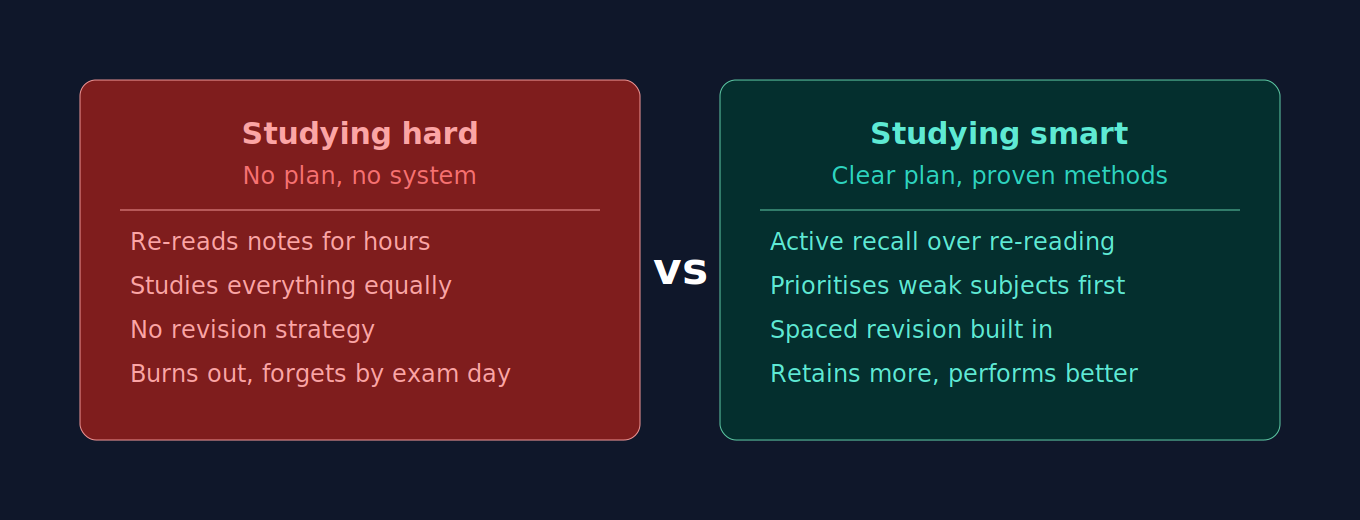
Hard work without the right strategy is just wasted effort.
The 5 Biggest Study Mistakes Students Make
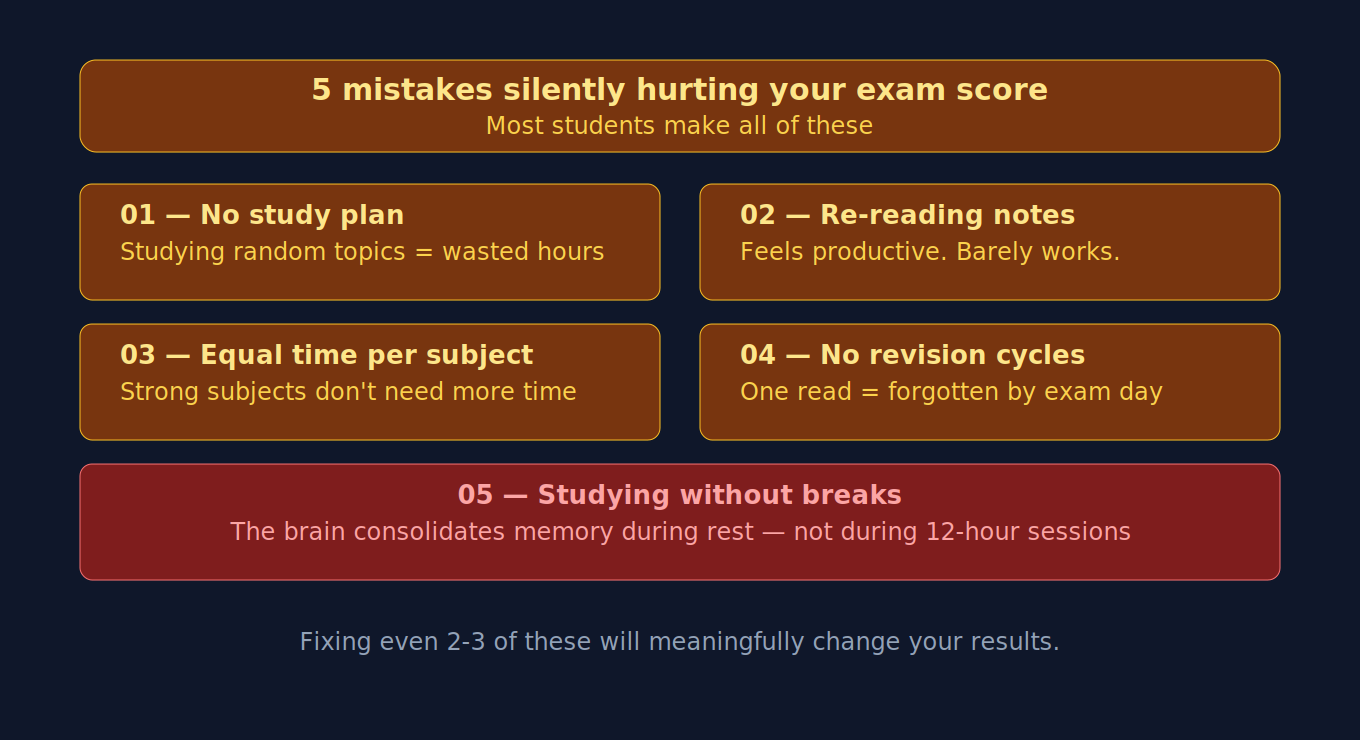
These 5 habits are silently hurting your exam performance.
1. Studying without a plan Opening random chapters the night before an exam is not preparation — it's panic. Without a structured timetable, students waste hours on topics they already know while completely ignoring weaker areas.
2. Reading instead of recalling Re-reading notes feels productive. It isn't. Research consistently shows that active recall — testing yourself on what you've learned — is far more effective than passive reading. If you can't explain it without looking at your notes, you haven't learned it yet.
3. Treating all subjects equally Not every subject needs the same amount of time. A student who is strong in Maths but weak in History needs a very different schedule than one who is the opposite. Generic timetables ignore this completely.
4. No revision strategy Studying something once and moving on is one of the biggest reasons students forget content by exam day. Spaced repetition — revisiting material at increasing intervals — is scientifically proven to improve long-term retention. Most students have never heard of it.
5. Burnout from over-studying Studying 12 hours straight without breaks doesn't just feel exhausting — it actively hurts learning. The brain consolidates memory during rest. Students who build structured breaks into their schedule consistently outperform those who don't.
What a Smart Study Plan Actually Looks Like
A genuinely effective study plan is not just a list of subjects and timings. It accounts for:
Your exam dates — Working backwards from the exam gives you a realistic picture of how much time you actually have per subject.
Your weak areas — These need more time, more revision cycles, and more active practice. A good plan weights subjects by difficulty, not by preference.
Your energy levels — Most people think best in the morning. Some peak in the evening. Your most demanding subjects should be scheduled during your peak hours, not squeezed in when you're already tired.
Revision cycles — The first read-through is just the beginning. A smart plan builds in at least 2-3 revision passes for every major topic before exam day.
Buffer time — Life happens. Plans that have zero flexibility collapse at the first disruption. Every good study schedule has buffer days built in.
The Science Behind Effective Studying
Decades of research in cognitive science has identified a few techniques that consistently outperform traditional studying:
Spaced Repetition — Instead of studying a topic once for 3 hours, study it for 1 hour today, revisit it after 2 days, again after 5 days, and once more before the exam. Retention improves dramatically.
Active Recall — After studying a topic, close your notes and write down everything you remember. This forces your brain to retrieve information, which strengthens memory far more than re-reading.
The Pomodoro Technique — Study in focused 25-minute blocks followed by 5-minute breaks. After 4 blocks, take a longer 20-minute break. This keeps concentration high and prevents mental fatigue.
Interleaving — Instead of studying one subject for hours, mix subjects within a session. It feels harder, but research shows it leads to better long-term understanding.
Most students know none of this. They study the way they've always studied — and wonder why the results don't change.
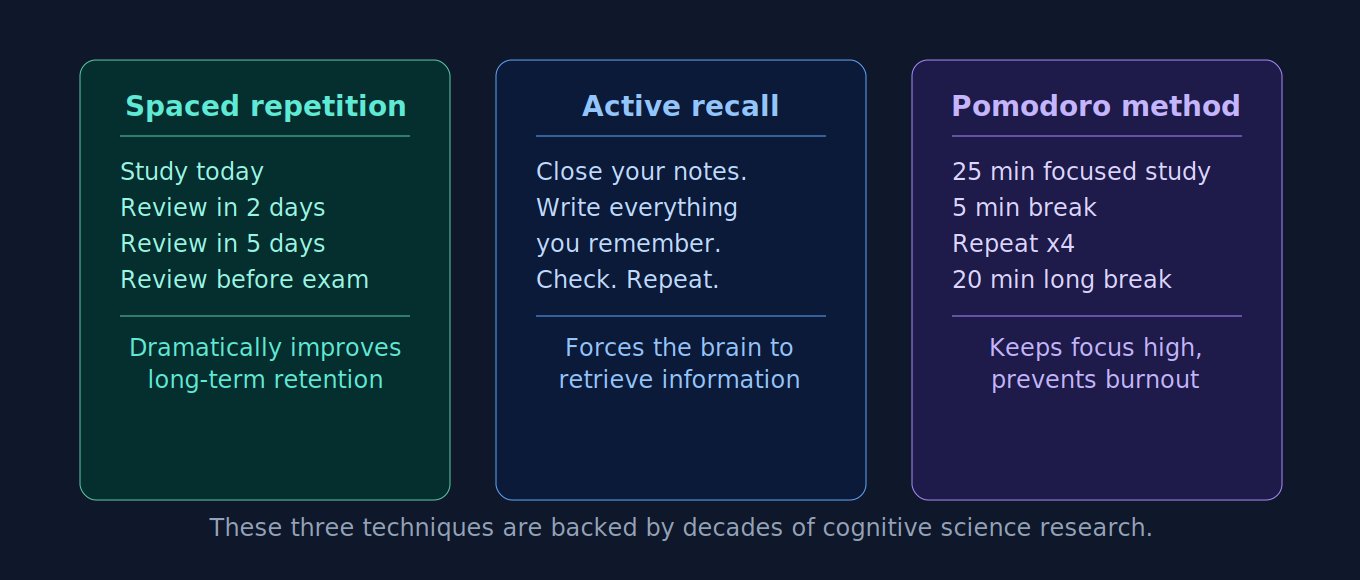
Three science-backed methods that top students swear by.
How to Build Your Own Study Schedule in 4 Steps
You don't need a complicated system. Here's a simple framework any student can follow:
Step 1 — List all your subjects and rate your confidence in each (1 = weak, 5 = strong). Subjects rated 1-2 get the most time.
Step 2 — Count the days until your first exam and subtract 2 days as buffer. That's your actual preparation window.
Step 3 — Assign subjects to time slots based on your energy levels — hardest subjects in peak hours, easier revision in low-energy hours.
Step 4 — Build in revision days every 5-6 days instead of always pushing forward with new content.
Follow this and you'll already be studying smarter than most of your peers.
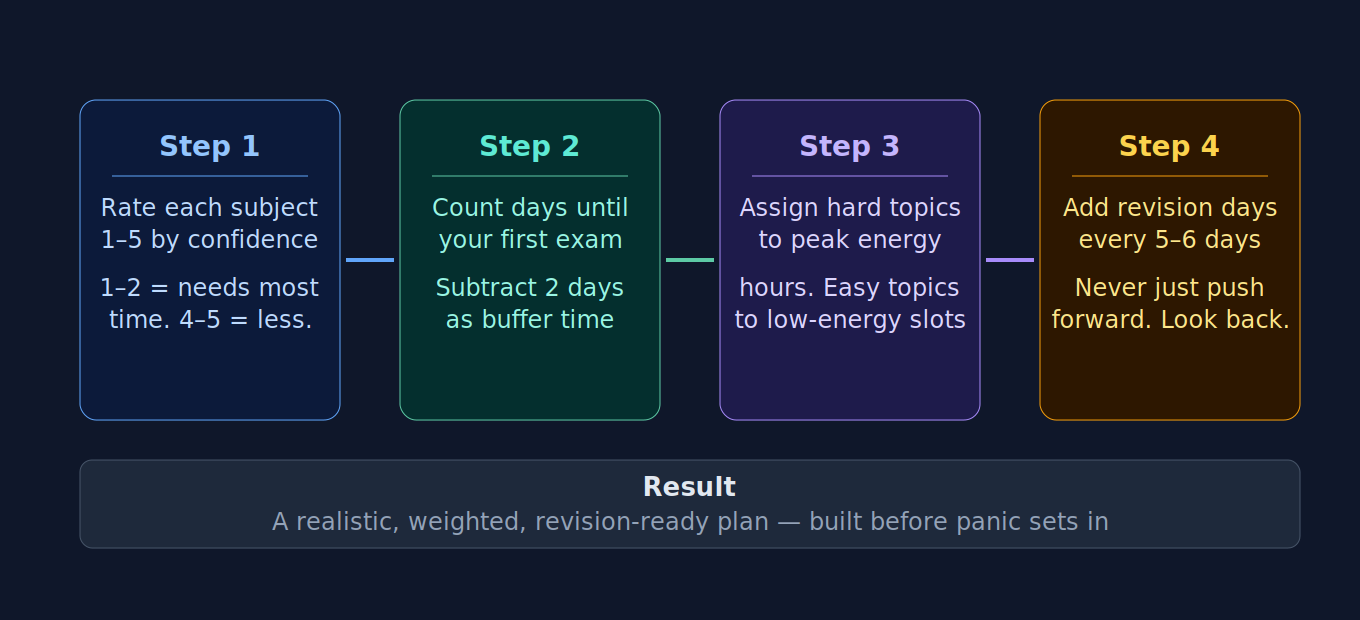
A simple 4-step framework anyone can follow before their next exam
When You Need More Than a Spreadsheet
Building and adjusting a study timetable manually takes time — and most students end up either making it too rigid (and abandoning it) or too vague (and ignoring it).
If you want a smarter starting point, Exam Brain on RentPrompts generates a personalized study timetable and acts as an AI study coach — taking your subjects, exam dates, and weak areas into account to give you a structured, realistic plan instantly.
But whether you use a tool or build it yourself — the principles above are what make the difference.
The Bottom Line
Studying more is not the answer. Studying better is.
A student with 4 hours and a smart plan will consistently outperform a student with 12 hours and no system. The science is clear. The framework exists. The only question is whether you'll use it.
Your next exam is coming. Start planning today — not the night before.
What's your biggest struggle when it comes to exam preparation? Drop it in the comments.
0 Comments

No comments yet. Be the first to start the discussion!