The AI Era Is No Longer Coming, It's Here
For years, "AI will replace humans" was a headline. In 2026, it's a dataset. According to the Stanford AI Index Report, AI performance has surpassed human baselines on every major benchmark introduced since 202m from image recognition to reading comprehension, natural language inference, and coding. AI global capital investment is projected to hit $527 billion in 2026 (Goldman Sachs). This isn't hype, this is the new normal. This article is not about AI replacing human worth or creativity. It is about something more important: understanding reality clearly, because that is the only way to make smart decisions about education, careers, healthcare, and society. Let's look at the actual evidence, domain by domain, with real numbers and real sources.
Why This Conversation Matters Right Now
We are living through the fastest shift in human capability tools since the invention of the printing press. Consider these facts from the 2025 Stanford AI Index Report: $527B
AI capex projected by companies in 2026 - (Goldman Sachs)
67%
Real GitHub bugs solvedb by AI vs 22% by humans under time limits - (SWE-bench)
95%+
AI accuracy in lung cancer & retinal disease detection - (Deep Learning, 2025)
4 X
AI outscores human experts on short-horizon tasks - (Stanford RE-Bench)
These are not projections. They are measurements. And they are accelerating. As the UN University Campus Computing Centre documented, AI has now achieved superhuman performance in image classification, visual reasoning, and English language understanding. The Evidence
A 2024 study at the University of Virginia tested physician diagnoses on difficult medical cases. One group used a chatbot (ChatGPT), the other used traditional reference tools. The results were startling:
- Doctors with AI assistance: approximately 76% accuracy
- Doctors without AI assistance: approximately 76% accuracy
- AI alone: over 92% accuracy
Similarly,
GPT-4 Medprompt achieved a
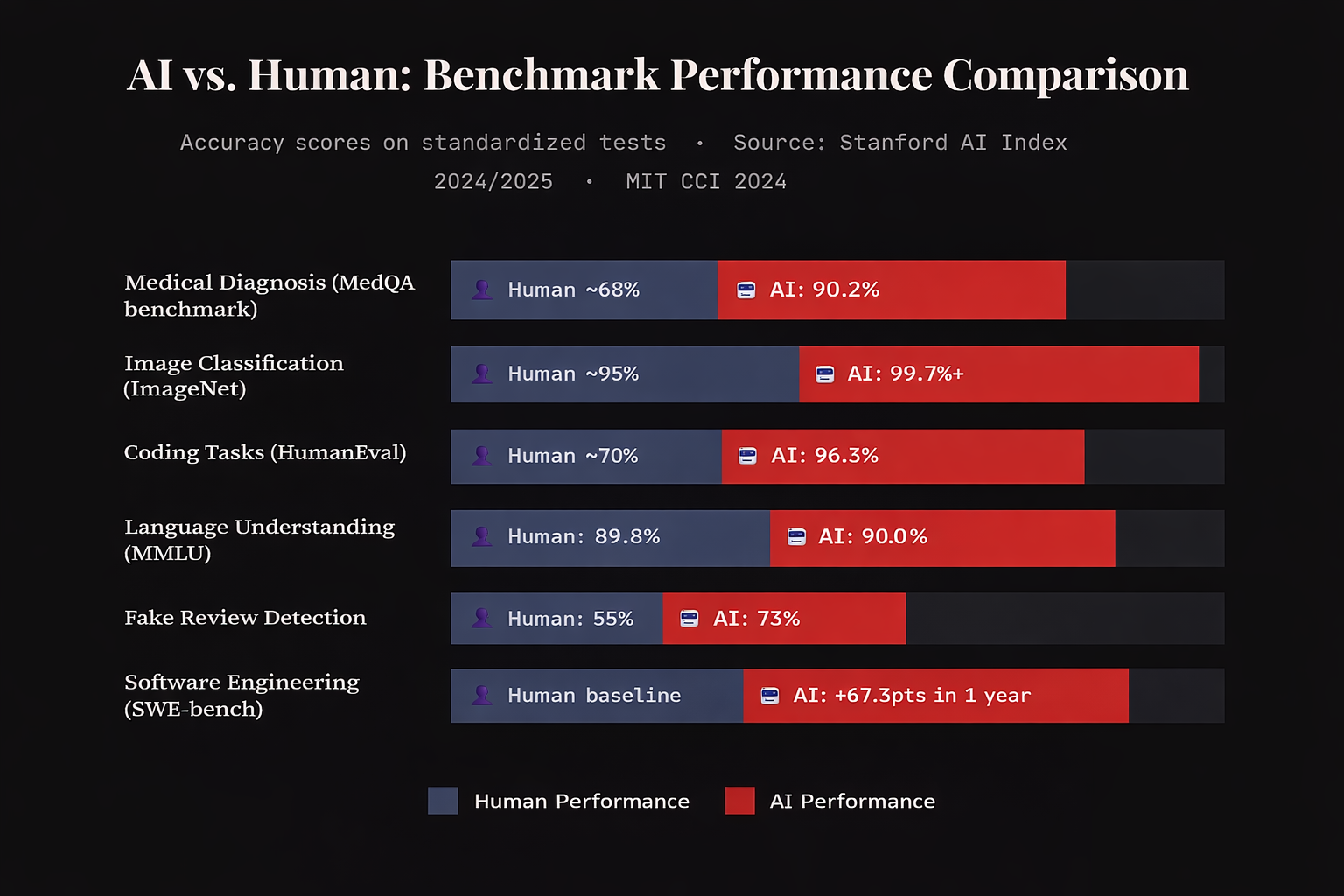
90.2% accuracy rate on the
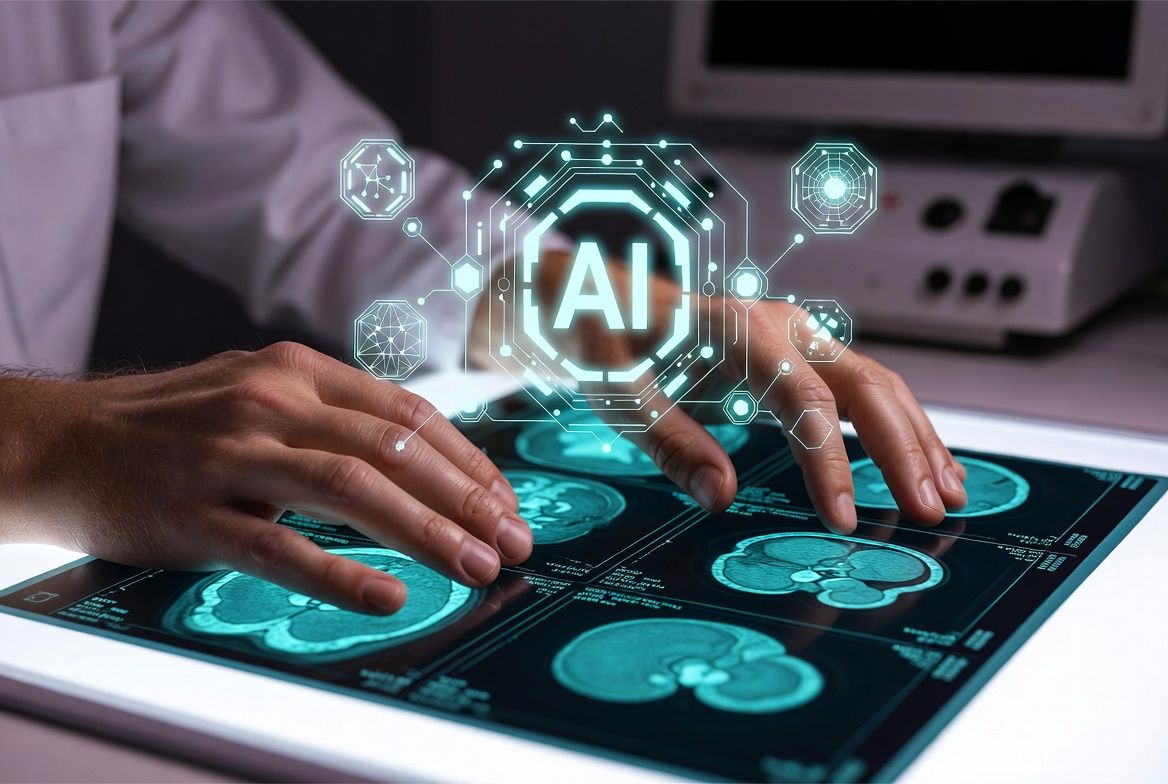
MedQA benchmarkIn radiology, AI models now detect certain cancers in mammograms with accuracy rivaling or exceeding specialist radiologists, and do so in milliseconds rather than minutes.
Chess & Strategic Games: The Most Complete AI Victory
Where AI Has Completely Left Humans Behind
Chess is the most thoroughly documented domain where AI has not just matched humans, it has completely surpassed them. Today's engines like Stockfish play at 3600+ Elo, far beyond the best human player Magnus Carlsen's peak of around 2882.
Beyond chess, Google DeepMind's
AlphaGo defeated 18-time world Go champion Lee Sedol in 2016. Go was previously considered computationally impossible for AI. AI solved it anyway, inventing moves that had never appeared in thousands of years of human play.
"The best move a human can make in chess today is to play the move the computer suggests, without second-guessing it. Any human analysis added to the process only makes things worse."
Coding: AI Is Already a Senior Developer
The HumanEval benchmark tests AI systems on real programming tasks, writing functions from scratch given only a description and some test cases. When introduced in 2021, AI systems solved roughly 66% of problems. By 2024, GPT-4 achieved 96.3%, a 30.4 percentage point improvement in just three years.
Real-World Impact: A
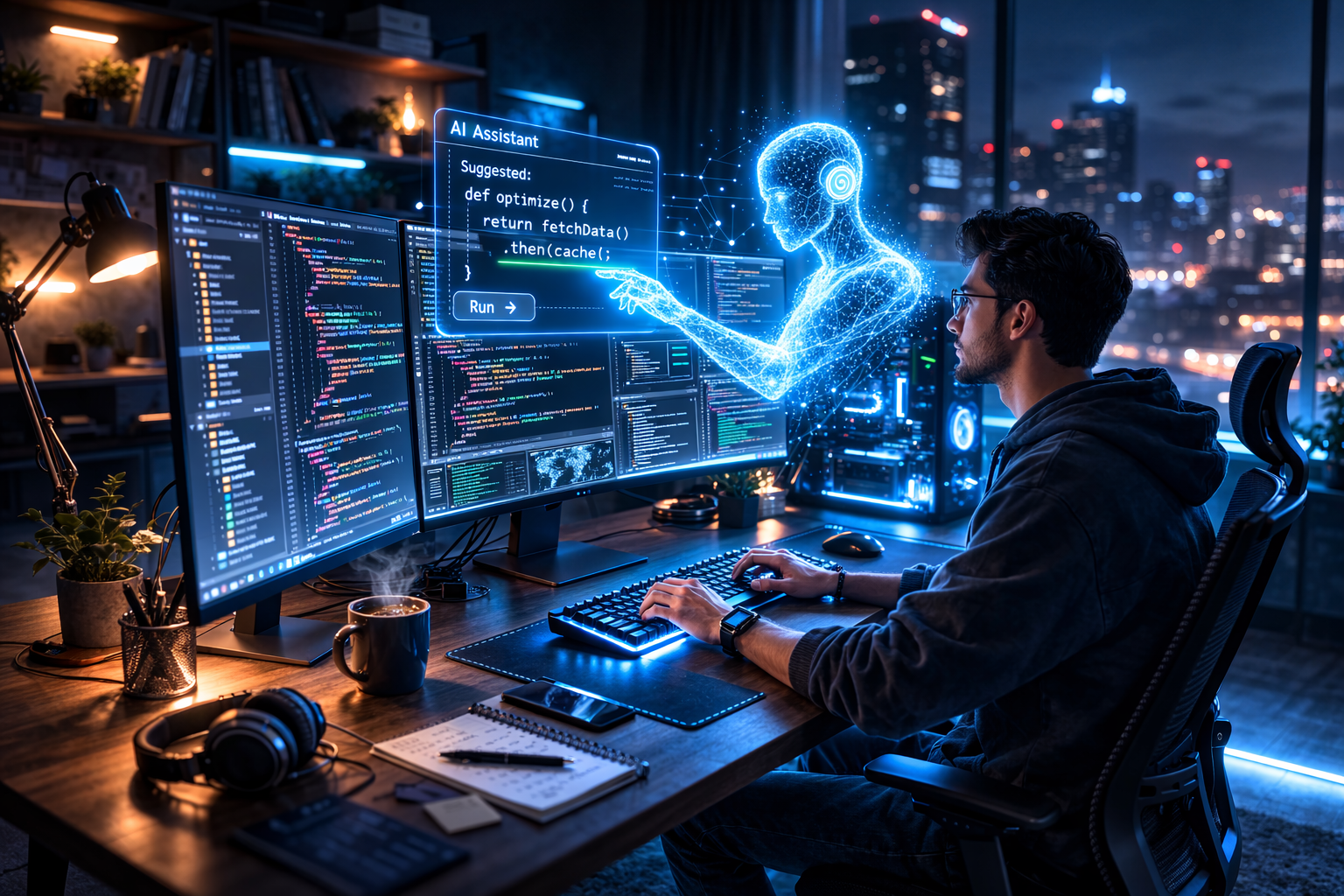
GitHub research study on Copilot found that developers using AI assistance completed coding tasks
55% faster than those working without it, and reported higher satisfaction. AI can write boilerplate, suggest algorithms, catch bugs, explain legacy code, and architect entire systems, often faster than a mid-level human developer.
Image Recognition: A Domain AI Has Owned for Years
Superhuman Sight
On the ImageNet benchmark, the gold standard for image classification, humans achieve roughly 95% accuracy. Current AI models exceed 99.7%.
The applications are profound. AI can now:
- Detect early-stage cancer in mammograms with accuracy rivaling senior radiologists
- Identify diabetic retinopathy from eye scans in seconds
- Spot structural defects in manufacturing at speeds no human inspector can match
- Recognize faces in crowds with uncanny accuracy (raising important civil liberties questions)
Language Understanding: AI Crosses the Human Baseline
The MMLU Milestone
The MMLU (Massive Multitask Language Understanding) benchmark tests knowledge and reasoning across 57 academic subjects, from history and law to physics and medicine. It requires genuine understanding, not just pattern-matching. The human baseline is 89.8%.
Data Analysis & Pattern Recognition: Speed Meets Scale
When the Dataset Is Too Big for a Human Mind
A human fraud analyst reviewing 10,000 financial transactions might take weeks and still miss subtle patterns. An AI does it in seconds, with higher accuracy, and at far lower cost. Banks and insurance companies have relied on AI fraud detection for years .
On fake review detection, a frequently cited experiment found a striking result:
- Human accuracy: 55%
- Human + AI accuracy: 69%
- AI alone: 73%
Perhaps the most dramatic example of AI pattern recognition is AlphaFold by Google DeepMind. For 50 years, predicting the 3D structure of a protein from its amino acid sequence was one of biology's hardest unsolved problems. AlphaFold solved it. It has since mapped over 200 million protein structures essentially the entire known protein universe and accelerated drug discovery in ways that would have taken human scientists decades.
What Humans Still Do Better,Honestly
A credible assessment of AI vs. humans must include where humans remain superior. The research here is just as clear and it points to what skills you should cultivate.
Where Human Intelligence Remains Essential
Creative collaboration: The
MIT CCI 2024 meta-analysis of 106 studiesfound that human-AI collaboration on creative tasks showed significantly greater gains than on decision-making tasks. When genuine creativity and originality matter, humans working with AI consistently outperform AI alone.
Emotional intelligence and human judgment: A grieving patient needs a human doctor's presence, not a chatbot's recommendation. A jury needs human moral reasoning. These are not small or temporary gaps they reflect the fundamentally social and embodied nature of human intelligence.
Unstructured physical environments: A human plumber improvising a repair in a cramped space, or a surgeon adapting to unexpected anatomy, still outperforms any current robotic system in these fluid, unpredictable conditions.
"Let AI handle the background research, pattern recognition, predictions, and data analysis, while harnessing human skills to spot nuances and apply contextual understanding. Let humans do what they do best."
What This Means for Your Future
AI is not science fiction anymore. The research from
Stanford,
MIT, and
Natureconfirms it with data: in well-defined domains, medical diagnosis, image recognition, coding, chess, language understanding, AI has surpassed human performance, sometimes dramatically and sometimes by margins that continue to grow every year.
That is not cause for despair. It is cause for clarity. The people who thrive in the next decade will not be those who compete hardest against AI in the tasks AI already does better. They will be those who understand the AI landscape honestly, know where genuine human value still lies, and build the wisdom to navigate an increasingly collaborative relationship between human and machine intelligence.
The future belongs not to AI alone, nor to humans who ignore AI, but to people who can tell the difference between the two, clearly, without hype on either side.