"AI is not replacing students. It's giving the prepared ones a 3× advantage."
We've all been there buried in textbooks at midnight, re-reading the same page five times, praying things stick before an exam. For decades, studying hard was the only answer. But today, studying smart with AI is rewriting the rules entirely.
Research from
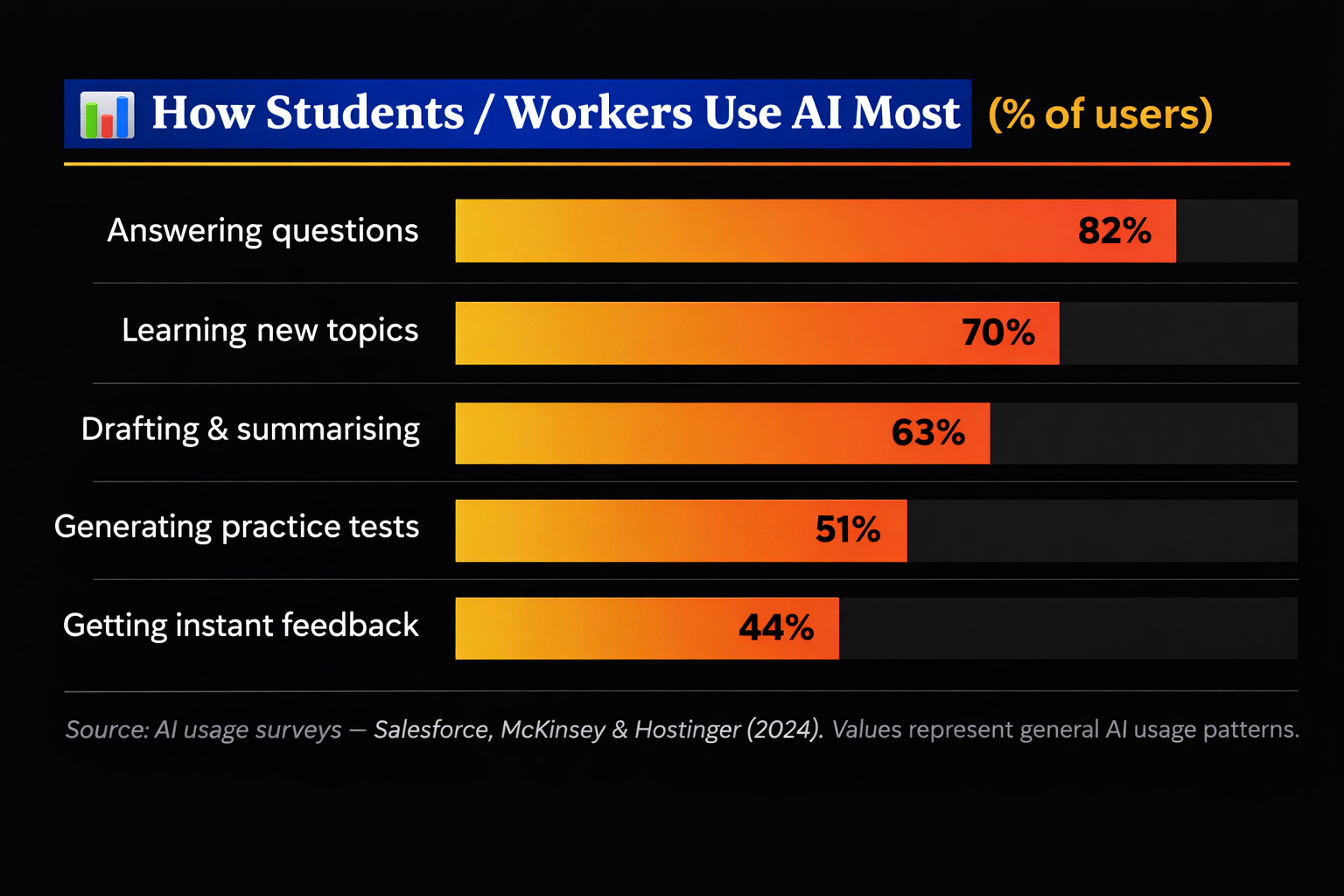
Harvard Business School showed that people using AI tools completed tasks 25% faster with over 40% higher quality output. In education, similar dynamics are playing out. AI tutors, smart flashcard systems, and instant feedback loops are giving students an edge that was simply unavailable just 3 years ago. This blog breaks down exactly how with real examples, real data, and tools you can use today.
40%
Average productivity boost reported by employees using AI daily
— Fullview / BCG Research, 2024
25%
Faster task completion by AI users vs. non-users in Harvard study
— Harvard Business School, 2023
9 hrs
Weekly time saved by frequent AI users in workplace studies
— Federal Reserve / Fullview, 2024
5 Powerful Ways AI Supercharges Your Studies
Whether you are a school student, college-goer, or a self-learner, these five AI-powered strategies can dramatically reduce the time you spend studying while improving what you actually retain.
1. Personalised Study Plans in Minutes
Traditional study plans are one-size-fits-all. AI tools like
ChatGPT or
Notion AI can analyse your syllabus, your exam date, and your weak spots then generate a day-by-day, topic-by-topic study schedule tailored specifically to you.
Mia, 2nd-year engineering student: She fed her exam syllabus and 3-week deadline into
ChatGPT. In under 2 minutes, it created a structured plan allocating more hours to her weakest subjects (Thermodynamics) and less to topics she'd already mastered. Her exam score improved by 18% compared to the previous semester.
2. Instant Explanations - No Waiting for a Tutor
Stuck on a concept at 11 PM? AI gives you a human-quality explanation in seconds. More importantly, it adjusts the explanation based on how you ask, you can request simpler language, an analogy, or a worked example until it clicks.
Why it matters: Research shows that immediate feedback loops are one of the most effective learning techniques (spaced repetition + active recall). AI makes this available 24/7 at zero cost.
This replaces hours spent searching YouTube tutorials, skimming Stack Overflow, or waiting for a teacher's email reply.
3. Auto-Generated Flashcards & Quizzes
One of the biggest time-drains in studying is creating your own practice material. Tools like
Quizlet AI, or simply asking
ChatGPT to "generate 20 quiz questions from this chapter" can cut that prep time from 2 hours to 5 minutes.
AI-generated quizzes also adapt: the more you get wrong, the more it tests that area. This mirrors the science of spaced repetition proven to improve memory retention by up to 50% compared to re-reading alone.
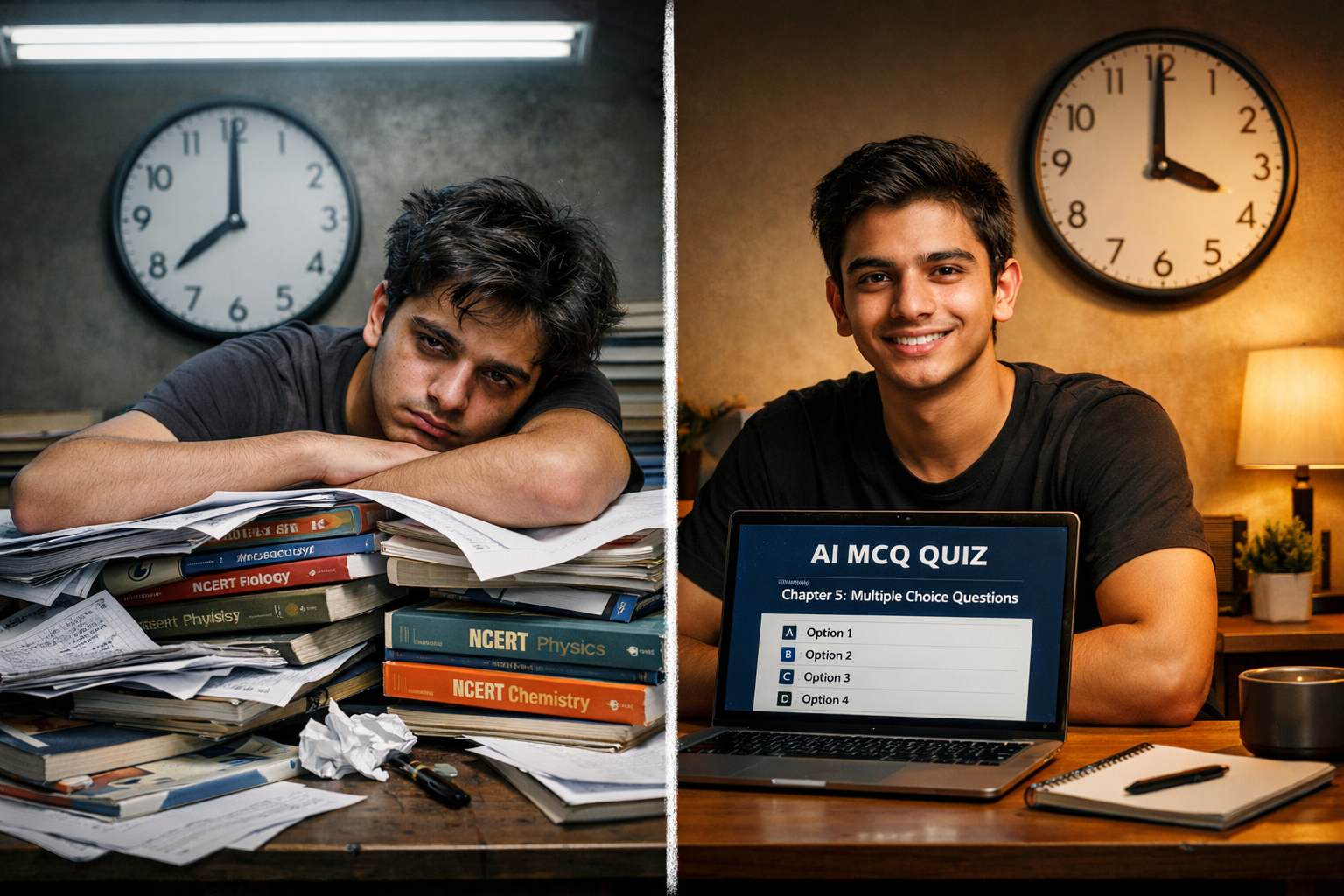
Rohan, Class 12 student preparing for JEE: Used an AI prompt to generate chapter-wise MCQs from his NCERT Biology chapters. He could complete a mock test on any topic in minutes, identify gaps instantly, and revisit only weak areas cutting his daily revision time from 4 hours to under 2.
4. Smarter Note-Taking & Summarisation
AI can summarise a 40-page chapter into a clean, structured one-pager. Tools like
Notion AI,
Claude, and
Perplexity can digest lecture transcripts, PDFs, and research papers then present the key concepts, definitions, and examples in bullet-point form.
This doesn't mean skipping the reading. It means your first pass is AI-assisted, so your second pass (the real learning) is already focused and efficient.
Pro tip: After AI summarises a chapter, ask it "What are the 5 most likely exam questions from this?" You'll often find that it surfaces exactly the high-value concepts saving enormous revision time.
5. Socratic Dialogue - Learn by Teaching AI
One of the highest-leverage study techniques is the Feynman Technique: explain a concept as if you're teaching someone who knows nothing. AI makes this interactive. You explain a topic to the AI, and it asks you follow-up questions, pokes holes in your reasoning, and points out what you've missed.
This transforms passive review into active, high-quality recall the kind that actually sticks during exams.
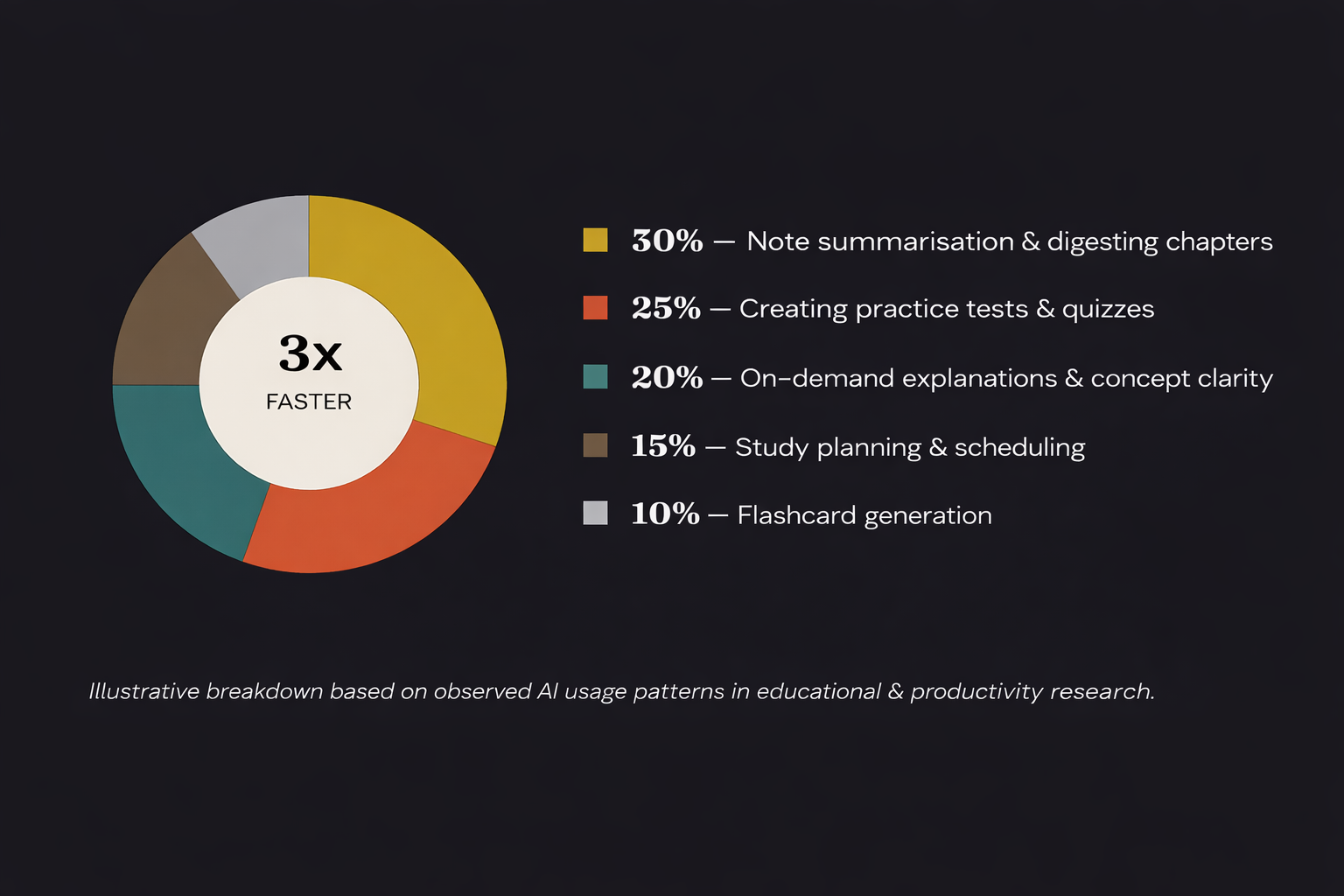
Where Does AI Actually Save Your Study Time?
Based on observed usage patterns among students and knowledge workers, here's roughly how AI compresses the learning cycle across five key activities:
You don't need expensive software. Many of the best AI study tools are free or have generous free tiers. Here's a curated shortlist:
Ask any question, get concepts explained, generate quizzes, create study plans, and practice Socratic dialogue in seconds.
Free tier available
Upload your notes, it automatically generates flashcards, multiple-choice tests, and fill-in-the-blank exercises. Adapts to your weak areas.
Free + Premium
Paste lecture notes and it summarises, creates action items, and organises your study material into structured, searchable pages.
Paid add-on
A research-grade AI search engine. Ask it deep academic questions and it provides sourced, cited answers, perfect for assignments and essays.
Free tier available
Record your lectures. Otter transcribes them in real time and creates a searchable, timestamped summary you can review later.
Free + Premium
One thing worth knowing if you want to skip the setup entirely
The biggest friction point with most AI tools isn't the tool itself, it's figuring out how to prompt it correctly. A poorly worded question gives you a generic answer. A well-engineered prompt gives you something actually useful.
That's where platforms like
RentPrompts save the time. Think of it as a marketplace where people have already done the hard work of building and testing AI prompts for specific study tasks. Instead of spending 20 minutes figuring out how to get
ChatGPT to generate a proper JEE mock test, you just use a prompt that's already been refined for exactly that.
Some of the ready-to-use applications students are finding genuinely useful:
- JEE Mock Test Generator: spits out chapter-wise MCQs in the right difficulty range, no manual setup needed
- Smart Study Notes Generator: paste any topic or chapter, get clean structured notes back in seconds
- And a growing list of others across subjects, competitive exams, and writing tasks
It's not a replacement for knowing how to use AI but if you're just getting started or want to save the trial-and-error phase, browsing a marketplace of pre-built, tested prompts is a pretty smart shortcut. Some are free, some are paid, but the time saved on prompt-crafting alone tends to be worth it.
5 Practical Tips to Get the Most Out of AI Studying
Be specific in your prompts: Instead of "explain photosynthesis," try "explain the light-dependent reactions of photosynthesis to me like I'm 15 years old, with a real-world analogy." Specificity = better answers.
Use AI to test yourself, not just teach you: After reading a chapter, prompt: "Ask me 10 questions on this topic and correct me." Active recall is far more effective than passive re-reading.
Verify important facts: AI is incredibly powerful but occasionally makes errors. For critical information medical, scientific, legal always double-check against a textbook or authoritative source.
Build a study system, not just a session: Use AI at the start of each week to plan your schedule, and at the end of each session to quiz yourself on what you covered. Consistency compounds.
Don't skip the deep work: AI accelerates preparation and review but actual thinking, writing, and problem-solving still needs to come from you. Use AI to clear the path, then walk it yourself.
AI in Education: The Momentum Is Undeniable
This isn't a trend. It's a structural shift in how humans learn. 78% of businesses already use AI in their operations (up from 55% just two years ago). In education, adoption is accelerating just as fast.
Key insight from Stanford's 2024 AI Index Report: Multiple 2023 studies confirmed that AI enables workers to complete tasks more quickly AND improve quality and critically, it narrows the skill gap between beginners and experts. For students, this means AI can level the playing field regardless of background or access to tutors. Students who learn to work with AI effectively aren't just saving time. They're building a skill set prompt engineering, critical AI evaluation, and AI-assisted research that employers value with a
43% wage premium over non-AI-skilled peers (Fullview /
BCG, 2024).
The 3× study multiplier isn't magic. It's the compounding effect of faster summarisation, smarter revision, personalised feedback, and zero waiting time every single day.
“The future doesn’t belong to the hardest worker. It belongs to the smartest learner.”