I’ve watched enough NEET aspirants burn through generic 180-question mock PDFs to know the real problem isn’t a lack of mock tests. It’s a lack of mock tests aimed at exactly the chapter you’re weak in, at exactly the difficulty you need right now.
That’s the specific gap the
NEET Mock Test Generator on RentPrompts is built to close. It’s an AI App listed on the Marketplace that generates custom NEET-style MCQs on demand, with dedicated subject tabs for Biology, Physics, Chemistry, and Zoology.
This guide covers what the tool actually does, how to use it step by step, a few tricks for getting better practice sets out of it, and where its limits are.
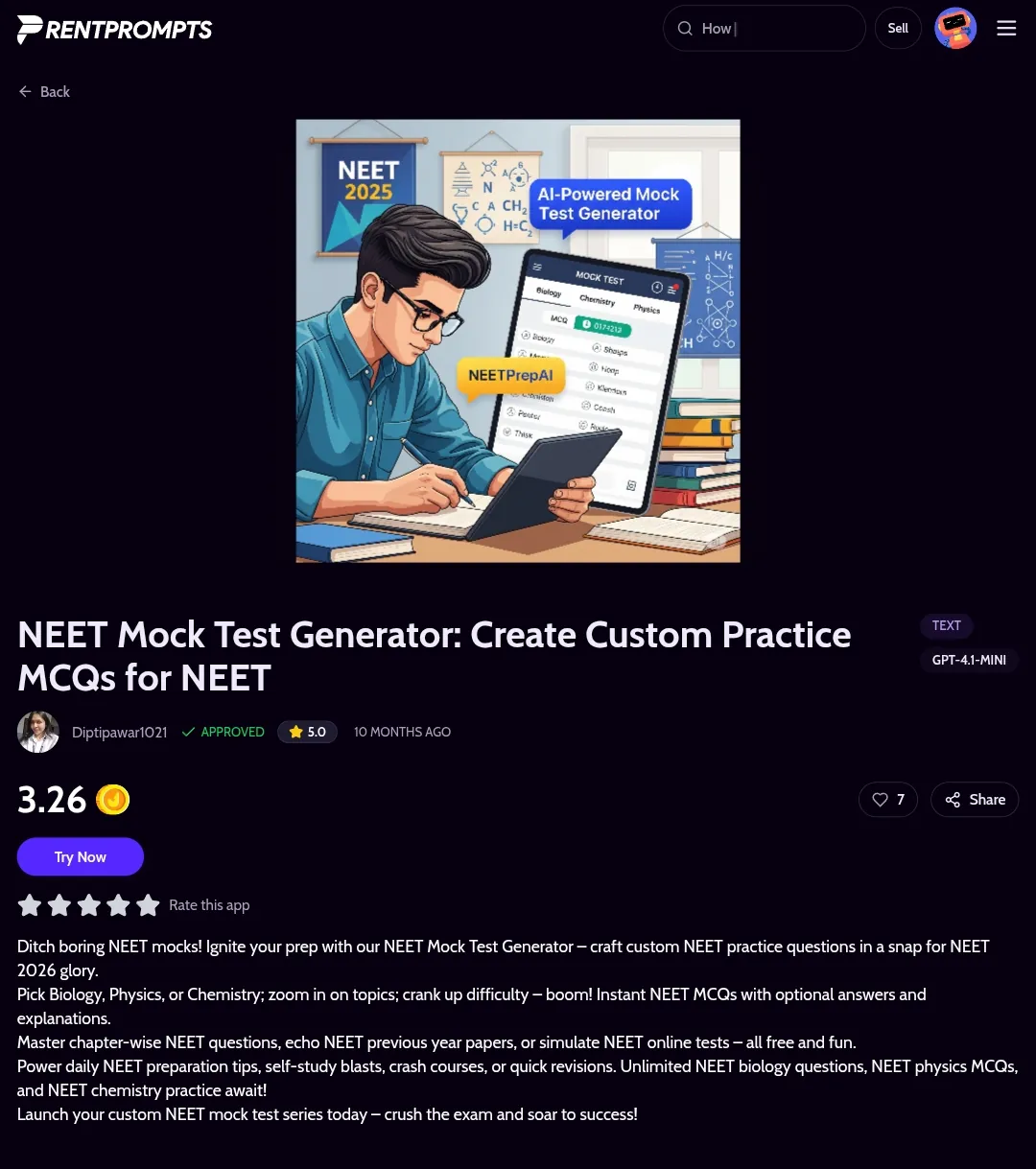
RentPrompts NEET Mock Test Generator listing page showing the creator, 5.0 rating, price in Joules, and Try Now button
TL;DR: How Does the NEET Mock Test Generator Work?
- It’s an AI App on the RentPrompts Marketplace that generates custom NEET MCQs across four subject tabs: Biology, Physics, Chemistry, and Zoology.
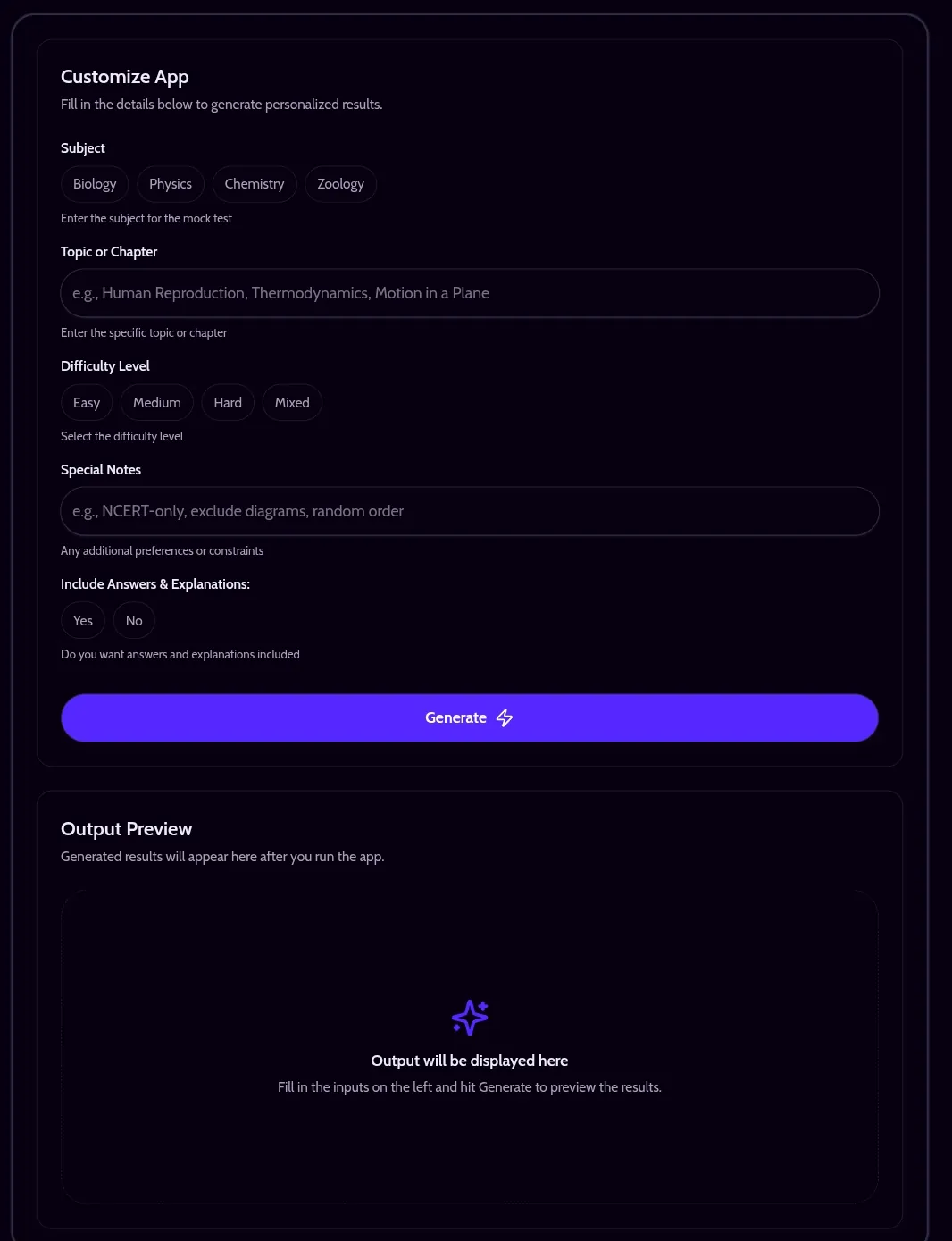
- You pick a subject, type in a specific topic or chapter, and choose a difficulty: Easy, Medium, Hard, or Mixed.
- A Special Notes field lets you add constraints like “NCERT-only” or “exclude diagrams” before generating.
- The tool generates instant MCQs, with a Yes/No toggle for including answers and explanations. It’s built on a text model (GPT-4.1-mini) and costs a small amount of Joules per generation.
- It’s community-built, currently rated 5.0 by early users, and approved on the platform.
That’s the short version. Here’s what actually matters when you sit down to use it.
What Is the NEET Mock Test Generator, in Simple Terms?
Think of it as a practice question machine you can point at exactly what you need to study. Instead of downloading a generic mock paper from a random website and hoping it covers what you’re weak in this week, you tell the tool the subject, the topic, and how hard you want the questions, and it writes a fresh set of MCQs on the spot.
It sits inside RentPrompts’
AI Apps category, built by a community creator rather than the RentPrompts team itself, which is common for tools in the Marketplace. The app was built and published by
diptipawar1021 , and it’s currently marked Approved with a 5.0 rating.
Why This Matters More Now: NEET Is Moving to Screen-Based Testing
Here’s a genuine reason this kind of practice matters more starting with NEET 2027, not less. Following the NEET-UG 2026 paper leak and re-examination, Union Education Minister Dharmendra Pradhan confirmed that NEET-UG will move from the traditional pen-and-paper OMR format to a full computer-based test (CBT) mode starting with the 2027 cycle. The National Testing Agency has since confirmed this to the Supreme Court, so this isn’t a rumor or a proposal; it’s the confirmed exam format going forward.
Since NEET UG moves to a computer-based test from 2027, practicing MCQs on a screen instead of paper isn’t just convenient anymore, it’s the exact format you’ll sit the real exam in. Aspirants who’ve spent years training on OMR sheets and printed papers are now preparing for an exam where reading questions off a monitor and selecting answers with a mouse is the actual test-day experience, not a simulation of it. A tool like this, where you’re already answering on-screen MCQs as part of your daily practice, lines up with that shift in a way a printed PDF simply can’t.
To be clear, the CBT switch changes the delivery format only. The syllabus, the 720 total marks, and the subject-wise question split remain based on NCERT Class 11 and 12 Physics, Chemistry, and Biology, so nothing about what you’re studying changes, only how you’ll eventually answer it.
Step-by-Step: How to Use the NEET Mock Test Generator
Step 1 — Open the app. Go to the
NEET Mock Test Generator page and log in, or create a free RentPrompts account if you don’t have one yet. Click “Try Now” to open the customize screen.
RentPrompts NEET Mock Test Generator Customize App form showing Subject, Topic, Difficulty, Special Notes, and answers toggle
Step 2 — Pick your subject. Choose from four tabs: Biology, Physics, Chemistry, or Zoology. If you’re prepping across all of them, it’s worth running separate sessions per subject rather than mixing them, since your weak topics are rarely evenly spread across subjects.
Step 3 — Type in a specific topic or chapter. This is the part generic mock tests can’t do. The Topic or Chapter field takes free text, so instead of a full-syllabus paper, type exactly what you’re revising: human reproduction, thermodynamics, motion in a plane, whatever’s on today’s list.
Step 4 — Pick a difficulty level. Choose Easy, Medium, Hard, or Mixed. Early revision benefits from Easy or Medium questions that confirm you understand the basics; closer to exam day, Hard or Mixed sets that mimic actual NEET difficulty are more useful.
Step 5 — Add Special Notes if you need to. This field is easy to miss but genuinely useful: you can type constraints like “NCERT-only,” “exclude diagrams,” or “random order” to shape the kind of questions you get. If you only trust NCERT-based questions for your prep, this is where you enforce that.
Step 6 — Decide on answers and explanations. Toggle Yes or No on “Include Answers & Explanations.” Turn this on if you’re studying solo and need to self-check; turn it off if you want to simulate exam conditions first and review afterward.
Step 7 — Generate and attempt the set. Click Generate, treat the output like a real mock: time yourself, attempt every question, and don’t peek at explanations until you’re done. Your set appears in the Output Preview panel below the form.
Step 8 — Review and regenerate. Once you’ve checked your answers, generate a fresh set on the same topic if you got several wrong, or move to the next topic if you scored well. This is where the tool earns its keep over a static PDF: you can keep drilling the same weak topic with new questions instead of just re-answering ones you’ve already memorized.
Why This Beats a Static Mock Test PDF
A few things make a generated, topic-specific mock genuinely more useful than a downloaded one for day-to-day prep:
- You’re never stuck redoing questions you’ve memorized. A generated set is fresh every time, so you’re actually testing recall, not remembering the position of the correct option from last week.
- You can drill your actual weak point. Most static mocks are full-syllabus, which is good for a final simulation but wasteful when you already know you’re weak specifically in, say, genetics or electrochemistry.
- Difficulty is adjustable. A fixed PDF is whatever difficulty the person who made it chose. Here, you control it directly.
- It fits into small pockets of time. A focused 10-question set on one topic is realistic for a study break in a way a full 180-question mock never is.
If you’re not sure how to fit this into an existing NEET prep schedule, here’s a simple structure that works well with a chapter-based revision plan:
- Monday to Friday, after finishing a chapter: Generate a 10 to 15 question set on that exact chapter at an easy-to-medium difficulty, with explanations turned on. This checks whether the concept actually stuck before you move on.
- Once a week, pick your three weakest topics from the past week: Generate a fresh, harder set on each, with explanations turned off. Time yourself. This is where the real testing happens, not the first pass.
- The night before a full-length mock exam: Skip the tool entirely. Use a proper full-syllabus mock instead, since pacing and stamina across the whole paper matter more than topic-specific practice at that point.
- The day after a full-length mock: Go back to whichever topics you missed on the mock and generate focused sets on exactly those, while the mistakes are still fresh.
The pattern underneath all of this is the same: use the generator for fast, targeted drilling between full mocks, not as a replacement for them. A tool that gives you unlimited focused reps is only useful if you’re actually pointing it at your weak spots instead of the topics you’re already comfortable with.
It’s a strong fit if you’re already following a structured NEET syllabus and need fast, topic-specific practice between study sessions, or if you’re self-studying without access to a coaching institute’s question bank. It’s less useful as your only prep resource. NEET rewards familiarity with the exact style and difficulty curve of the real exam, and no single AI tool should replace working through official previous year papers and at least a few full-length, proctored-style mocks before exam day.
Common Mistakes to Avoid
Keeping the topic too broad. Typing “Biology” instead of a specific chapter into the Topic or Chapter field defeats the purpose. The tool is most useful when you get specific about exactly what you’re revising.
Skipping the Special Notes field. It’s easy to leave this blank and never notice it exists, but it’s where you can request “NCERT-only” questions or exclude diagram-based ones. If your coaching material is strictly NCERT-based, leaving this blank means you might get questions styled after other sources.
Turning explanations on every time. If you always see the explanation immediately, you’re training recognition, not recall. Do a first attempt with explanations off to simulate exam pressure, then turn them on for review.
Never increasing the difficulty. Sticking to easy questions the whole way through your prep will make you confident and then blindsided on exam day. Ramp the difficulty up as your revision progresses.
Treating every AI-generated question as gospel. Cross-check anything that looks off against your textbook or NCERT material, especially for numerical or borderline conceptual questions. Any AI generation tool can occasionally produce an imprecise question, so verification is still your job.
Not tracking what you got wrong. The tool generates fresh questions each time, so if you don’t note your weak spots somewhere, you’ll lose the thread between sessions. Keep a simple running list of topics you keep missing.
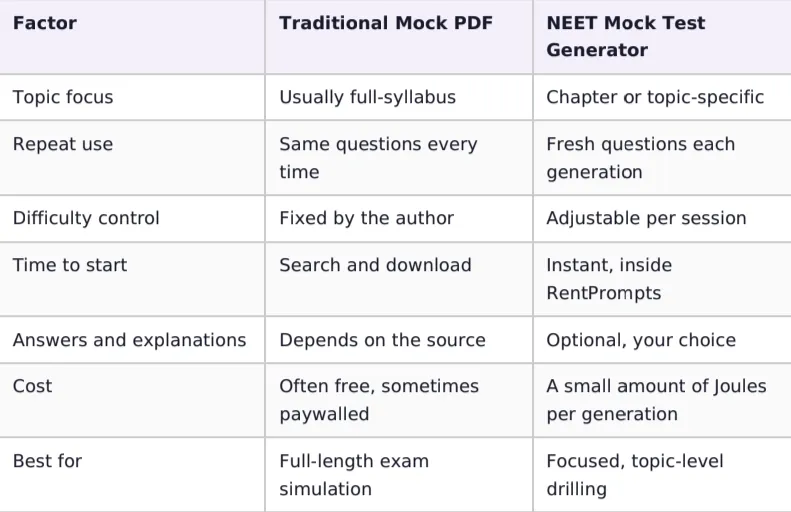
NEET Mock Test Generator vs a Traditional Mock Test PDF
Neither fully replaces the other. A full NEET-pattern mock closer to exam day still matters for pacing and stamina. This tool is what fills the gap in between, the daily, topic-specific practice that a static PDF can’t flex to match.
App Details and Trust Signals
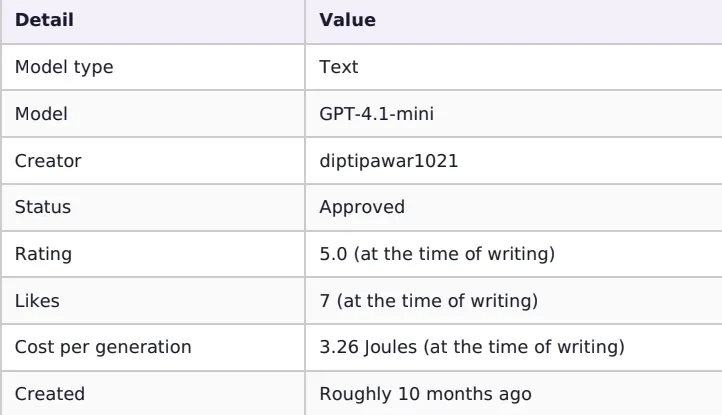
Since this is a community-built AI App rather than an official RentPrompts feature, it’s worth knowing what’s actually behind it before you rely on it for exam prep:
The listing also includes lifetime updates and priority support as part of what you get when you use it, per the app’s own listing page. Rating, like count, and pricing are the kind of numbers that shift as more people use the app, so treat the figures above as a snapshot rather than something to quote as current; check the live listing page for the up-to-date numbers.
Frequently Asked Questions
- Is the NEET Mock Test Generator free to use? It uses Joules, RentPrompts’ inplatform currency, at roughly 3.26 Joules per generation at the time of writing. You’ll need some Joules in your account, which you can pick up through the Pricing page .
- Can I choose specific chapters, not just a subject? Yes. Type any chapter or topic into the Topic or Chapter field, across Biology, Physics, Chemistry, or Zoology, rather than generating full-subject questions. You can also add constraints like “NCERTonly” in the Special Notes field.
- Are the questions actually NEET-pattern MCQs? The tool is designed to mimic the structure of NEET-style multiple choice questions, but since it’s AI-generated, always cross-check tricky or numerical questions against your textbook rather than treating every question as verified exam content.
- Does it include answers and explanations? Yes, both are optional. You can generate questions alone to simulate exam conditions, or include answers and explanations for self-study review.
- Who built this tool? It’s a community-built AI App by RentPrompts creator diptipawar1021, currently marked Approved with a 5.0 rating from early users.
- What if I have an issue with the app itself? The app’s listing includes a direct support link through RentPrompts’ Discord. For anything platform-wide, RentPrompts’ general. Support page is the right place to reach out.
- Can I use this alongside other NEET prep resources? Yes. It’s built for focused, topic-level drilling, which pairs well with full-length mock exams and your regular textbook study rather than replacing either.
- How is this different from just asking a general AI chatbot for NEET questions? A general chatbot can write questions too, but this app is purpose-built for the format: it’s structured around NEET’s actual subjects, supports topic narrowing and difficulty control as dedicated options, and keeps your generations organized inside your RentPrompts account rather than scattered across a chat history.
- Will the difficulty and topic settings actually match NEET’s real exam style? The tool aims to mimic NEET’s MCQ format and difficulty tiers, but since it’s communitybuilt and AI-generated, treat it as strong supplementary practice rather than an official NEET question bank. Cross-referencing against NCERT and previous year papers is still worth doing, especially in the final weeks before the exam.
- Does this tool help with the NEET 2027 CBT format? Yes, indirectly but meaningfully. Since NEET-UG 2027 onward will be conducted as a computer-based test rather than the old pen-and-paper OMR format, practicing MCQs on a screen, reading the question, selecting an option, and moving to the next one, builds the exact interaction pattern you’ll use on exam day. The tool doesn’t simulate the official NTA testing software specifically, but the general habit of screen-based MCQ practice is now directly relevant rather than just a convenience.
Conclusion
The NEET Mock Test Generator isn’t trying to replace a full NEET mock exam. It’s solving a narrower, more common problem: needing fast, focused practice on exactly the topic you’re revising right now, at a difficulty you control. Used alongside proper full-length mocks closer to exam day and your regular NCERT-based study, it’s a genuinely useful addition to a NEET prep routine rather than a shortcut around one. �