
Featured insight
The Architecture of an AI Ecosystem: How the Building Blocks Connect

diptipawar1021
September 25, 2025•5 min read
#learning
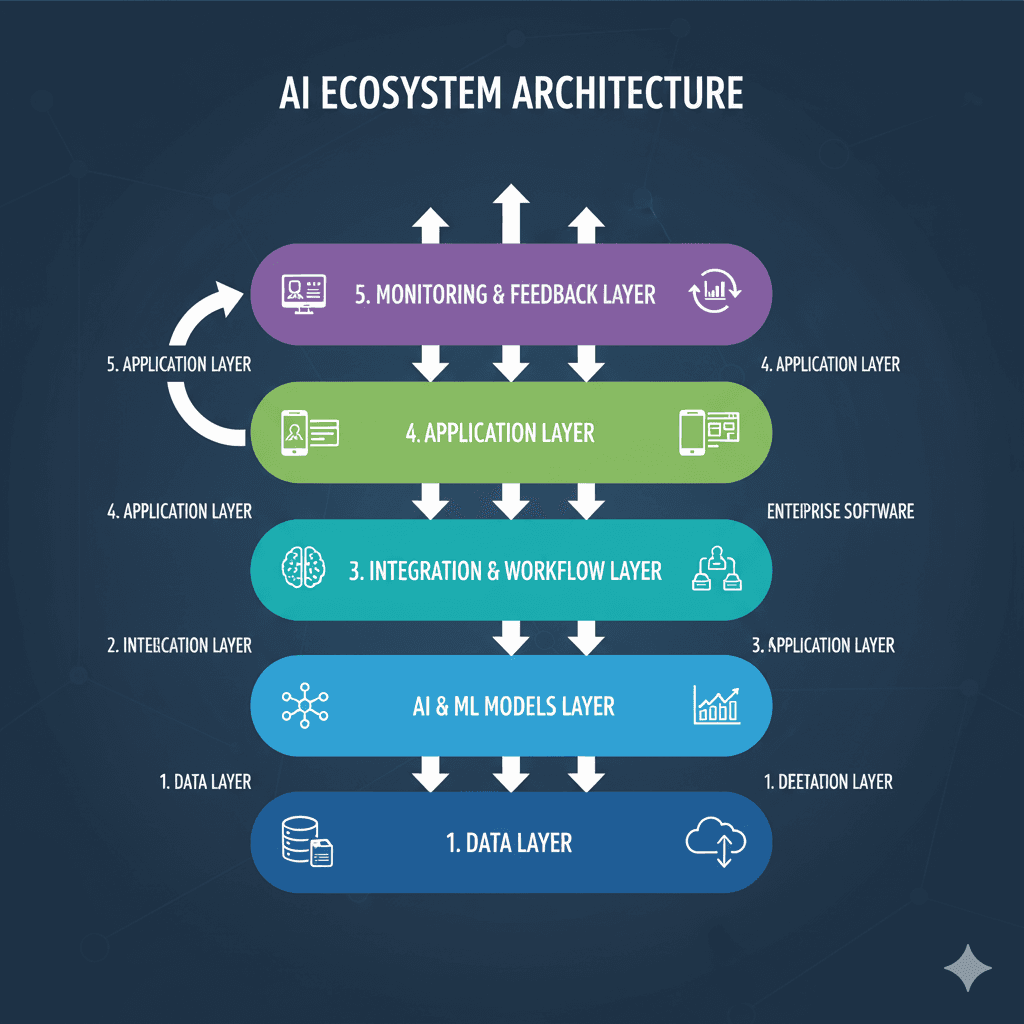
To transition from AI tools to AI ecosystems, it’s essential to understand the architecture behind these systems. Think of an AI ecosystem as a connected nervous system: each component plays a role, and data flows seamlessly across layers to enable intelligent decision-making.
Core Components of an AI Ecosystem
- Data Layer
- Purpose: Centralizes all raw and processed data from across the organization.
- Includes: Databases, cloud storage, IoT sensor data, CRM systems.
- Impact: Provides a single source of truth for all AI models and workflows.
- AI & ML Models Layer
- Purpose: Processes data to extract insights, predictions, or content.
- Includes: NLP models, image recognition, predictive analytics, generative AI.
- Impact: Delivers intelligence that can automate decisions or assist humans.
- Integration & Workflow Layer
- Purpose: Connects different AI models, tools, and business processes.
- Includes: API integrations, workflow automation, RPA bots.
- Impact: Ensures seamless communication between AI components and business functions.
- Application Layer
- Purpose: Presents intelligence to users or automates actions.
- Includes: Chatbots, dashboards, reporting tools, automated emails, or dynamic websites.
- Impact: Converts AI outputs into actionable business value.
- Monitoring & Feedback Layer
- Purpose: Tracks performance, errors, and learning loops.
- Includes: Analytics dashboards, model performance metrics, automated alerts.
- Impact: Enables continuous improvement and adaptive intelligence.
How Workflows Connect
In an AI ecosystem, workflows link the layers:
- Data flows from the Data Layer into AI models for processing.
- Insights from the AI & ML Layer are routed via the Integration Layer to relevant applications.
- The Application Layer interacts with users, while feedback loops from usage feed back into data pipelines, enabling continuous learning.
Example:
A retail AI ecosystem could have:
- Customer behavior data → processed by predictive analytics → generates product recommendations → displayed in app or email → feedback collected → fed back into models for better future predictions.
Platforms Enabling Ecosystem Architecture
Platforms like RentPrompts
allow businesses to design the architecture of their AI ecosystem without extensive coding. They enable:
- Connecting multiple AI models (text, image, audio, video)
- Automating workflows across departments
- Monitoring performance and scaling solutions efficiently
By understanding the architecture, businesses can design ecosystems tailored to their specific needs, rather than patching together isolated tools.
Next in the Series → Steps to Implement Your First AI Ecosystem Successfully
0 Comments

No comments yet. Be the first to start the discussion!