
Featured insight
The Evolution of GPT: From Humble Beginnings to the Future

Atharva_Barche
January 16, 2025•5 min read
#casestudy
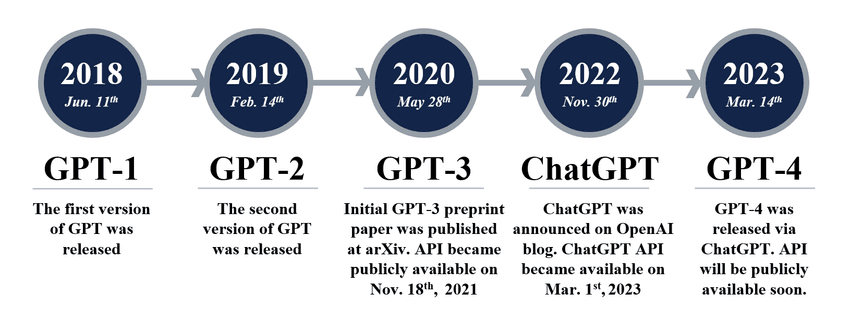
GPT-1: The Foundation (2018)
Key Features:
- Introduced the transformer architecture for natural language understanding.
- Focused on unsupervised pre-training on large text datasets followed by fine-tuning for specific tasks.
- Model size: 117 million parameters.
Limitations:
- Struggled with generating coherent long-form content.
- Limited in understanding nuanced contexts.
GPT-2: The Leap Forward (2019)
Key Features:
- Significant scale-up with 1.5 billion parameters.
- Demonstrated impressive text generation capabilities, including storytelling and coherent responses.
- Introduced concerns about potential misuse, leading to a staggered release.
Key Differences from GPT-1:
- Better handling of context and continuity in responses.
- Ability to generate more human-like text.
- Larger training datasets and improved pre-training methodologies.
GPT-3: The Game-Changer (2020)
Key Features:
- Massive leap with 175 billion parameters.
- Few-shot, one-shot, and zero-shot learning capabilities, reducing dependency on fine-tuning.
- Versatile applications, from coding assistance to creative writing.
Key Differences from GPT-2:
- Enhanced ability to perform diverse tasks with minimal input.
- More coherent and context-aware text generation.
- Opened doors to widespread commercial applications.
GPT-4: A Step Toward AGI (2023)
Key Features:
- Multimodal capabilities: understanding and generating text and images.
- Improved reasoning, contextual understanding, and ethical alignment.
- Fine-tuning options for specific industries and tasks.
Key Differences from GPT-3:
- Integration of visual inputs alongside text.
- Significantly improved handling of complex queries.
- Enhanced safeguards to reduce biases and harmful outputs.
The Future of GPT: GPT-5 and Beyond
Anticipated Features:
- True multimodal integration: handling video, audio, and 3D data.
- Advanced personalization: adaptive models tailored to individual user needs.
- Near-human reasoning capabilities, approaching Artificial General Intelligence (AGI).
- Robust ethical frameworks and transparent decision-making.
Key Differences from GPT-4:
- Expanded understanding of real-world contexts.
- Enhanced interactivity and proactive suggestions.
- Broader accessibility for non-technical users through simplified interfaces.
Conclusion
The growth of GPT highlights the incredible advancements in AI capabilities over a short span. From GPT-1’s foundational principles to GPT-4’s multimodal prowess and the anticipated evolution into AGI, the series continues to redefine what’s possible with AI. The future of GPT promises even greater innovation, pushing the boundaries of human-machine collaboration.
0 Comments

No comments yet. Be the first to start the discussion!